Intermediate Learning Pathway
Become a well-rounded piano player.


Intermediate pianists
If you know the fundamentals and are ready to expand your harmonic vocabulary and play more expressively, this class is for you.
3 months
Dion Todman will guide you through six grades of instruction with daily practice plans and assessments.
Go beyond the basics
By the end of this class, you'll be able to create richer piano parts, learn songs quickly, and adapt your playing across a wide range of musical styles.
Take the next step
Keep your momentum going with advanced classes and guided pathways to push your playing further.
What you'll learn
This class will help you move beyond basic progressions and start thinking like a professional piano player. You’ll build a richer harmonic toolkit and apply theory across real musical styles.
- Build fluency with both hands
- Expand your chord vocabulary
- Learn modern styles
- Play more fluidly across the keyboard


Curriculum
Stay focused with this step-by-step learning program designed by our expert team of music educators.
Your guided Learning Pathway
In this three-month program, pianist Dion Todman will help you move beyond the intermediate plateau with a clear, structured path forward. You'll build stronger harmony, rhythm, and melody skills while learning to create richer arrangements, all through guided exercises and 1:1 video feedback.

Back to Foundations
We'll kick off the class by reinforcing the fundamentals that every great pianist relies on.
As you refine your technique and strengthen your two-hand coordination, you'll also build a deeper connection between melody and harmony.
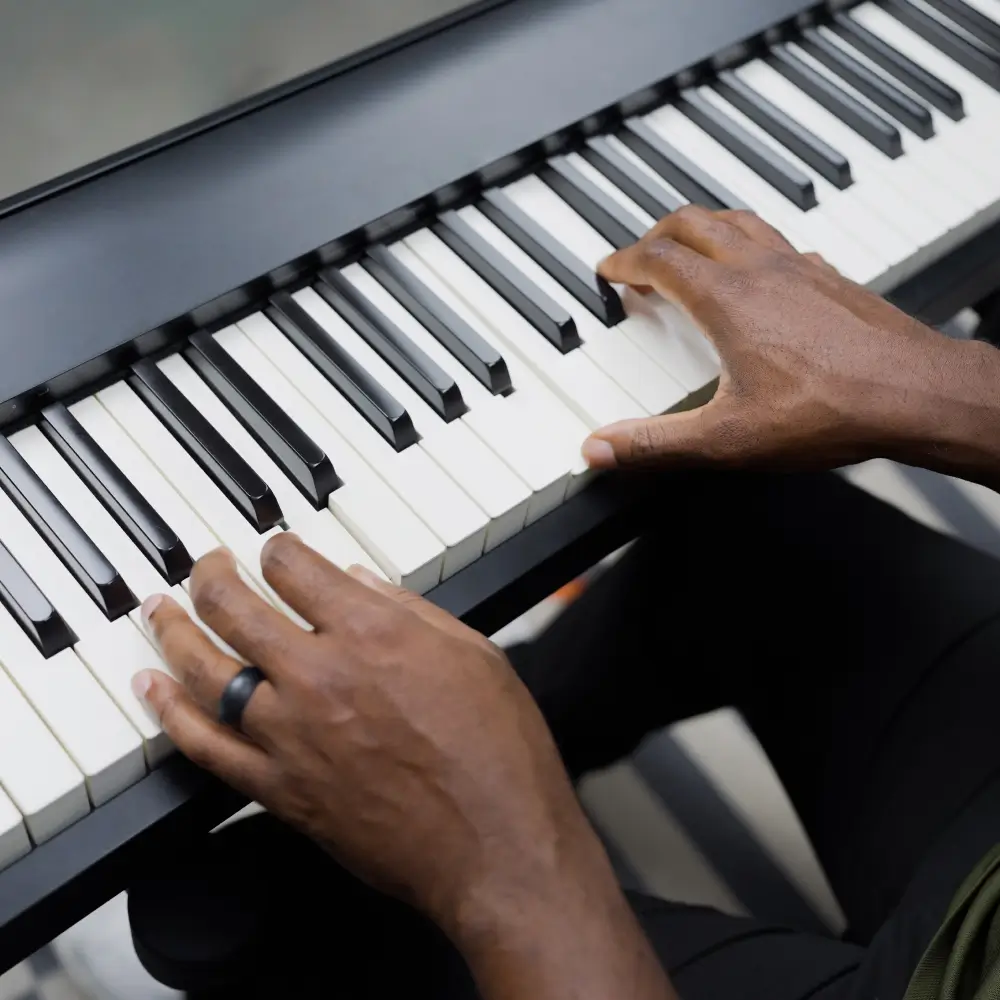
Intermediate Skills
In this grade, you'll discover how a few new harmonic and rhythmic ideas can completely transform the sound of a chord progression.
These lessons are all about expanding your vocabulary so you can make simple progressions come to life.
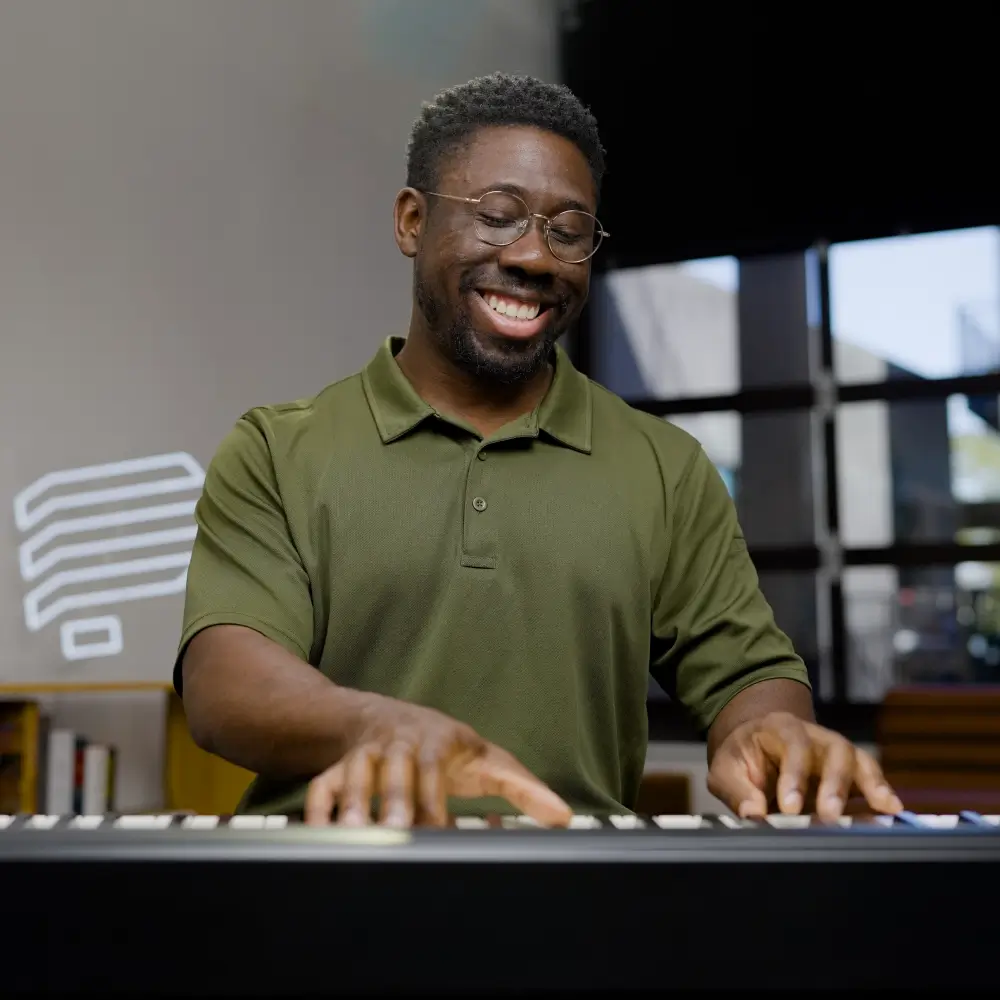
From Chords to Music
With your new expanded vocabulary, it's time to make those chords move.
In this grade, you'll learn how to shape melodies, basslines, and inner voices into expressive piano parts.
Grade 4. Scaling Up Your Skills
Next, you’ll move scales out of the theory world and apply them as a creative tool. You’ll learn how scale knowledge helps you improvise, understand melodies, and easily navigate different keys.
Grade 5. Rhythm, Groove, and Feel
In this grade, you'll focus on what separates good players from great ones: feel. You'll strengthen your groove, timing, and two-hand coordination so your playing sounds more natural and expressive.
Grade 6. Styles
In the final grade, you’ll apply everything you’ve learned in this class to different musical styles. You’ll learn how rhythm, voicing, and feel change across genres so you can adapt to a huge variety of genres and styles and fit in with any band.
Grade 1. Back to Foundations
In Grade 1, you’ll review and internalize the foundational skills you’ll need to make it through the intermediate pathway – including 7th chords and inversions, two-hand coordination, and playing melodies.

Day 1. How chords work
You’ll start by reviewing chord functions through common progressions. You’ll see how understanding the relationship between chords makes it easier to transpose and identify progressions by ear.
Day 2. Adding movement to your chords
Now, you’ll explore how musicians can make the same basic progression feel completely different. Dion will show you how you can experiment with concepts like key, tempo, timbre, and rhythm to bring a familiar progression to life.
Day 3. Chord inversions
In this lesson, you’ll continue reviewing inversions as a tool for smoother chord movement. Focus on how the top note of each chord creates a natural melody inside your progressions.
Day 4. 7th chords
Dion will now show you how to add 7ths to triads and use them tastefully in a progression. You’ll also work on two-hand rhythm and coordination.
Day 5. Playing melodies on the piano
In this lesson, you’ll shift the focus to melody by reviewing the treble clef and learning a full right-hand melody. This lesson will help you connect notation and phrasing at the keyboard.
Day 6. Two-hand coordination
In Day 6, you’ll return to the same musical idea from Day 5 and build it into a fuller arrangement. Dion will help you combine harmony and rhythm across both hands.
Day 7. Intermediate fundamentals workout
This workout reviews inversions, arpeggios, and two-hand coordination so your intermediate skills feel more natural under your fingers.
Performance pieces
Choose a song to learn that takes what you worked on in Grade 1 and puts it in a musical context. Here, you'll get to jam with a live-recorded band of professional L.A. musicians as your backing track.
Personalized feedback
Submit a video of yourself playing a performance piece from this grade for custom video feedback on your playing from our team of pro pianists.
Final quiz
Make sure you're ready to move on to Grade 2.
Grade 2. Intermediate Skills
In this grade, you’ll move beyond basic progressions by adding richer harmony, stronger rhythmic feel, and more interesting movement between chords. By the end of the grade, you’ll start hearing how intermediate-level piano parts are built around melody, accompaniment, and musical momentum.
Day 1. How to make your chords sound “intermediate”
You’ll take apart a Stevie Wonder-inspired progression to learn how borrowed chords and chromatic bass movement can transform a simple progression.
Day 2. Secondary dominants: III7
In this lesson, you’ll expand your chord vocabulary with new secondary dominant sounds. Dion will show you how these chords create added tension and make progressions feel more unexpected.
Day 3. Intro to bossa nova
Now, you’ll explore the sound and feel of bossa nova while adding 9ths and 13ths to your chord voicings. This lesson combines richer harmony with Brazilian-inspired rhythm.
Day 4. Bossa nova (continued)
You’ll deepen your bossa nova groove by adding more left-hand movement. Dion will help you combine bass patterns and right-hand chord voicings into a fuller rhythmic part.
Day 5. Aura Lee
In Day 5, you’ll learn the melody to a timeless American tune and continue building your sight-reading skills. This lesson focuses on melody, phrasing, and recognizing familiar musical patterns.
Day 6. Aura Lee (continued)
You’ll build a fuller arrangement of Aura Lee by adding chords, bass movement, and arpeggiation. Dion will show you how the melody connects to the harmony underneath it.
Day 7. Intermediate chords workout
This workout will help you review the richer harmony and rhythmic ideas from the grade.
Performance pieces
Choose a song to learn that takes what you worked on in Grade 2 and puts it in a musical context. Here, you'll get to jam with a live-recorded band of pro L.A. musicians as your backing track.
Personalized feedback
Submit a video of yourself playing a performance piece from this grade for custom video feedback on your playing from our team of pro pianists.
Final quiz
Make sure you're ready to move on to Grade 3.
Grade 3. From Chords to Music
In Grade 3, you’ll learn how to turn static chords into moving mosaics by shaping inner melodies, basslines, and richer harmonic textures. By the end, you’ll be able to build more complex arrangements with motion and tension.
Day 1. Harmonic inner voices
To kick off Grade 3, you’ll explore inner voice movement by creating small melodies inside your chords. This technique adds motion and color while the rest of the harmony stays grounded.
Day 2. Melodic inner voices
Now, you’ll use inner voice movement more melodically, creating riffs and mini melodies inside a chord progression. This lesson helps you bring more personality into the rhythm parts you play.
Day 3. Playing basslines on the piano
In this lesson, you’ll shift your focus to the left hand and learn how basslines can create both rhythm and melody. Dion will help you build a funky bassline that supports the harmony.
Day 4. Harmonizing with triad pairs
You’ll now learn how triad pairs can help you harmonize melodies across the keyboard. This technique gives you a practical way to turn a simple melody into a fuller musical idea.
Day 5. Slash chords
You’ll create tension between the bass note and the chord above it by using slash chords. This lesson will help you read, understand, and use slash chords in progressions.
Day 6. Put it all together
You’ll bring together the techniques from this grade to create a fuller piano arrangement. You’ll combine inner voices, bass movement, and harmonic color to make your chord progressions feel more dynamic and alive.
Day 7. Inner voice movement workout
Finally, you’ll lock in the chordal movement concepts from the grade with a fun and musical workout.
Performance pieces
Choose a song to learn that takes what you worked on in Grade 3 and puts it in a musical context. Here, you'll get to jam with a live-recorded band of pro L.A. musicians as your backing track.
Personalized feedback
Submit a video of yourself playing a performance piece from this grade for custom video feedback on your playing from our team of pro pianists.
Final quiz
Make sure you're ready to move on to Grade 4.
Grades 4-6
In these final grades, you’ll strengthen your scale knowledge, deepen your groove, and apply your skills across different styles. You’ll connect theory to real music so you can improvise, arrange, and adapt your playing in a wider range of musical situations.
Grade 4. Scaling Up Your Skills
In this grade, you’ll turn scales into a practical creative tool for making your own music. You’ll build stronger scale fluency to improve your improvisation and melody writing.
Day 1. Major and minor scales + arpeggios
To start Grade 4, you’ll review major and minor scale formulas and connect them to arpeggios. This lesson helps you understand how scales support transposing and learning new songs, as well as improvising.
Day 2. Pentatonic scales
You’ll explore the major pentatonic scale and practice it through practical note groupings. This scale will help you create memorable melodies without overthinking every note.
Day 3. Blues scale
Now, you’ll learn major and minor blues scales and practice them in a musical way. Dion will help you understand how the “blue” note shapes modern styles.
Day 4. Improvising solos with scales
In this lesson, Dion will show you how to use scales and chord tones to create improvised melodies. You’ll focus on developing a motif instead of simply running up and down a scale.
Day 5. Improvising with melody
Next, you’ll learn the melody to When the Saints Go Marching In and use it as a guide for improvisation. The goal is to create variations that stay singable and true to the original melody.
Day 6. When the Saints Go Marching In
You’ll add chords, left-hand shapes, and a New Orleans-inspired rhythmic feel to the melody. This lesson will help you connect harmony and groove.
Day 7. Scales and improvisation workout
In this workout, you’ll review the scale sounds from the grade so you can keep building fluency with improvisation.
Performance pieces
Choose a song to learn that takes what you worked on in Grade 4 and puts it in a musical context. Here, you'll get to jam with a live-recorded band of pro L.A. musicians as your backing track.
Personalized feedback
Submit a video of yourself playing a performance piece from this grade for custom video feedback on your playing from our team of pro pianists.
Final quiz
Make sure you're ready to move on to Grade 5.
Grade 5. Rhythm, Groove, and Feel
In this grade, you’ll learn how to make your piano parts feel more alive by strengthening your rhythm, groove, and two-hand coordination. By the end of this grade, you’ll be better able to feel rhythm in your body and translate that to the keyboard.
Day 1. One-chord funky rhythms
In this lesson, Dion will help you think of your right hand like a drummer and your left hand like a bassist. You’ll use a one-chord vamp to build groove and hand independence.
Day 2. Two-hand syncopation
Now, you’ll split rhythmic roles between your hands and practice switching between different feels. This lesson will strengthen your ability to feel rhythm in your body and translate it to the keyboard.
Day 3. Intermediate two-hand chords
In Day 3, you’ll explore rootless voicings and upper extensions by splitting harmonic roles between your hands. This lesson will open the door to richer modern piano sounds.
Day 4. Bluesy bassline
Dion will show you how chromatic bass movement can connect chords and create groove. You’ll learn how the left hand can add tension and momentum to a progression.
Day 5. House of the Rising Sun
You’ll apply your two-hand skills to a classic folk song in 6/8 time. This lesson focuses on melody, bass movement, and the feel of triple time.
Day 6. House of the Rising Sun (continued)
Now, you’ll build a fuller arrangement of the classic song with chords, arpeggios, and two-hand coordination. Dion will help you fill in the harmony while keeping the song’s movement flowing.
Day 7. Two-hand rhythm and coordination workout
To cap off the grade, you’ll strengthen the rhythmic control you built throughout the grade with another workout.
Performance pieces
Choose a song to learn that takes what you worked on in Grade 5 and puts it in a musical context. Here, you'll get to jam with a live-recorded band of pro L.A. musicians as your backing track.
Personalized feedback
Submit a video of yourself playing a performance piece from this grade for custom video feedback on your playing from our team of pro pianists.
Final quiz
Make sure you're ready to move on to Grade 6.
Grade 6. Styles
In this final grade, you’ll apply your new intermediate skills across different genres. You’ll learn how voicing and feel change depending on the style so you can become a more adaptable pianist.
Day 1. R&B
To kick off this last grade, you’ll revisit familiar harmonic material through an R&B lens. Dion will show you how you can create a soulful sound using chromatic bass movement and pedal tones.
Day 2. Rock
This lesson focuses on making your playing feel bold and energetic by using riffs and chromatic movement.
Day 3. Rock (continued)
You’ll expand your rock vocabulary with blues-scale riffs and articulation. You’ll leave this lesson with three riffs you can pull out of your back pocket whenever you’re playing rock.
Day 4. Folk
Now, you’ll switch into a 3/4 feel and explore lighter accompaniment patterns. Dion will help you use flowing arpeggios to accompany singers or other instrumentalists.
Day 5. Jazz/gospel
You’ll return to When the Saints Go Marching In with more rhythmic nuance and gospel-inspired color. This lesson adds even more personality to a familiar tune.
Day 6. Funk
Now, you’ll focus on pocket and rhythmic precision. Dion will show you how harmony can stay simple while rhythm becomes the main character.
Day 7. Styles workout
This final workout helps you lock in the core style-based techniques from the grade and prepare for the last performance pieces.
Performance pieces
Choose a song to learn that takes what you worked on in Grade 6 and puts it in a musical context. Here, you'll get to jam with a live-recorded band of pro L.A. musicians as your backing track.
Personalized feedback
Submit a video of yourself playing a performance piece from this grade for custom video feedback on your playing from our team of pro pianists.
Final quiz
Make sure you're ready to move on to new challenges.

REAL students
Don’t take our word for it, take theirs
Heading 1
Heading 2
Heading 3
Heading 4
Heading 5
Heading 6
Lorem ipsum dolor sit amet, consectetur adipiscing elit, sed do eiusmod tempor incididunt ut labore et dolore magna aliqua. Ut enim ad minim veniam, quis nostrud exercitation ullamco laboris nisi ut aliquip ex ea commodo consequat. Duis aute irure dolor in reprehenderit in voluptate velit esse cillum dolore eu fugiat nulla pariatur.
Block quote
Ordered list
- Item 1
- Item 2
- Item 3
Unordered list
- Item A
- Item B
- Item C
Bold text
Emphasis
Superscript
Subscript

FULL REFUND, NO QUESTIONS ASKED
If you don’t get better, we’ll give you your money back
We’re so confident that Pickup Music can help you make progress that we’re underwriting your membership with a 60-day satisfaction guarantee.

Your Instructor
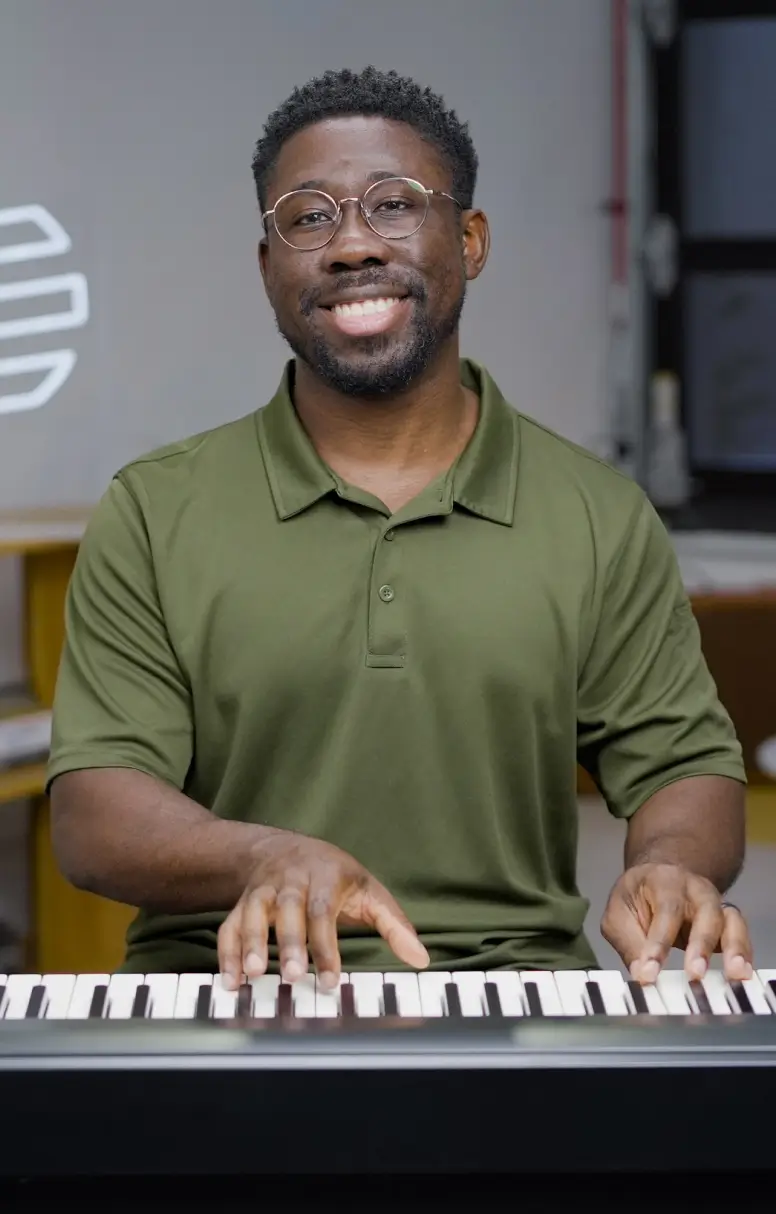
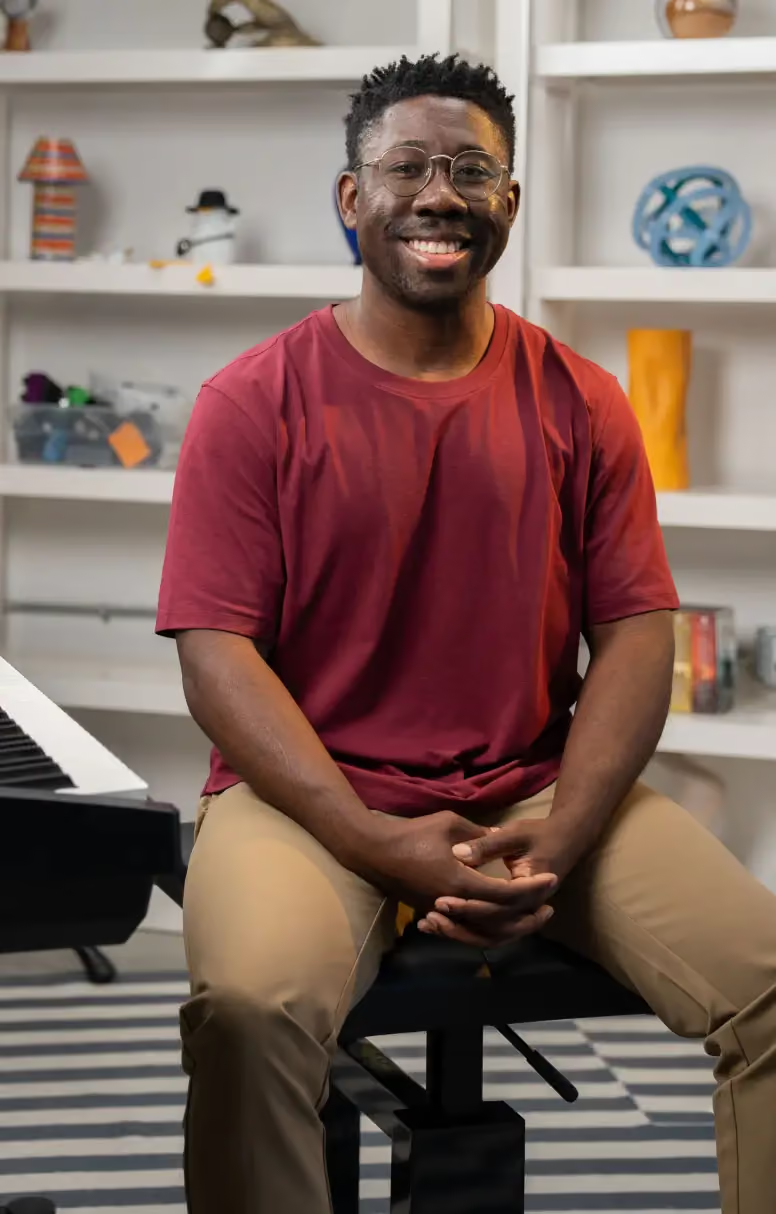
Dion Todman
Dion Todman is a pianist, composer, and educator who helps aspiring pianists build a strong musical foundation through clear, music-first instruction.
Explore LessonsWhat’s in every Pickup Music membership?
Try free for 14 days
1,000+ Lessons

All skill levels

Interactive tabs

Track your progress

Daily practice plans

Live lessons every week
Limitless learning.
All-inclusive access to every instrument and course.


Frequently asked questions

The most structured approach to learning music