Blues Learning Pathway
Your step-by-step guide to the fundamentals of blues guitar.


Beginner guitarists
Designed specifically for beginners and intermediates. Start with the absolute basics and build up to expressive blues solos.
3 months
Seth will guide you through 6 grades of instruction with daily practice plans and assessments.
Solo like the greats
By the end of this Learning Pathway, you'll be able to improvise your own expressive solo over any 12-bar blues song.
Take the next step
Once you've mastered blues, keep progressing with advanced Master Classes and other guided learning paths.
What you'll learn
Get started with blues from the ground up. Seth will guide you through the 12-bar blues, basics of soloing, and expressive playing techniques to make your guitar sing.
- Learn how to improvise blues guitar solos in any key
- No theory necessary – learn to follow your ear
- Hone expressive techniques used by blues legends

.avif)
Curriculum
Stay focused with this step-by-step learning program designed by our expert team of music educators.
Grade 1. The 12-Bar Blues
Learn how to play the 12-bar blues form in any key with power chords and open chords.

Overview
In this grade, you’ll learn about the most fundamental and commonly-used form (AKA structure or chord progression) used to create blues songs: the 12-bar blues. You’ll leave this grade ready to play a 12-bar blues in any key with power chords. Once you build this foundational skill, you'll be ready to get started with blues guitar soloing!
Day 1. Introducing the 12-Bar Blues
Get to know the essential chord road map for a blues song.
Day 2. Let’s Play! 12-Bar Blues in D
Get comfortable with a 12-bar blues in a new key.
Day 3. “The Thrill is Gone”
Learn how achieve a “darker” feel with a 12-bar blues in a minor key.
Day 4. How to Play Power Chords
Learn to play a simple and versatile dyad.
Day 5. Applying Power Chords
Work on playing a 12-bar blues with power chords.
Day 6. Transposing Power Chords
Learn how to play a 12-bar blues in any key.
Day 7. Final Assessments
Recap what you learned and make sure you’re ready for grade 2.
Grade 2. Intro to Blues Soloing
Get acquainted with call & response as you learn simple licks to build your first blues solo.
Overview
This grade of the Learning Pathway is all about learning how to play blues guitar solos. Let’s be honest, that’s why you’re here, right? Over the next 10 days, you’ll learn how to craft two simple-but-effective blues solos (and hopefully have fun doing it.) This will set you up to improvise your own solos from scratch in grade 3.
Day 1. How to use motifs
Learn how to harness the power of motifs to tell a musical story.
Day 2. How to play a "response" motif like B.B. King
Start working on your first blues guitar solo with a B.B. King-style "call" motif.
Day 3. Add a "response" lick on the IV chord
Start a musical conversation with a response lick to your call motif.
Day 4. "Response" lick over the V chord
Add another response lick into the mix as you work up to a full solo.
Day 5. Add a 2nd "Response" Lick
Work on playing a 12-bar blues with power chords.
Day 6. Easy Lead Line in A
Today, we'll change keys and start on a new solo.
Day 7. Response Lick in A
Add a response lick into the mix.
Day 8. 2nd Response Lick in A
Continue building up your lead guitar vocabulary with a new response lick.
Day 9. 3rd Response Lick in A
You're almost there! Add another lick as you build toward another full solo.
Day 10. Putting It All Together in a Full Solo
Incorporate all of the licks you learned in A to play through your 2nd full blues solo.
Day 11. Final Assessments
Congrats on completing grade 2! Here, you'll complete some assessments to ensure that you're ready for grade 3.
Grade 3. Pentatonic and Blues Scales
Develop the melodic vocabulary you need to create solos from scratch over any blues song.
Overview
This is where the magic really begins. Over the next 14 days, you'll learn how to improvise your own blues guitar solos using the minor pentatonic & blues scales.
Day 1. Lower Part
Start exploring the minor pentatonic with half of one scale position.
Day 2. Upper Part
Continue exploring the minor pentatonic and complete one full position of the scale.
Day 3. Full Scale
Solidify one full position of the minor pentatonic and work on applying it in a lead-guitar context.
Day 4. The Nut is a Finger
Develop an understanding of how the open position minor pentatonic relates to fretted positions of the scale.
Day 5. Dexterity Drills: 1st to 2nd Finger
Learn how to add dynamics to your solos with slurs.
Day 6. Dexterity Drills: 1st to 3rd Finger
Continue honing your ability to incorporate hammer-on and pull-off slurs in your playing.
Day 7. Dexterity Drills: 1st to 4th Finger
Strengthen your pinky finger by working on hammer-on and pull-off slurs.
Day 8. Minor Pentatonic Main Position - Lower Part
Start working on the minor pentatonic scale shape that will allow you to solo in any key.
Day 9. Minor Pentatonic Main Position - Upper Part
Continue working on the minor pentatonic scale shape that will allow you to solo in any key.
Day 10. Full Minor Pentatonic Scale in Position
Master the minor pentatonic scale shape and practice applying it in a musical context.
Day 11. The Blues Scale - Lower Part
Learn how to spice up your solos with the "blue" note.
Day 12. The Blues Scale - Upper Part
Continue internalizing the blues scale and practice applying it in a musical context.
Day 13. The Blues Scale - Full Scale
Use the full blues scale to improvise your own solo lines.
Day 14. Final Assessments
Wrap up with some final thoughts and make sure you're ready to tackle grade 4!
Grade 4-6.
Bring your playing to life with expressive techniques that will form the basis of your unique sound as a guitarist.
Grade 4. Vibrato and Bending
Now that you’ve put in the work to build your blues soloing vocabulary, we’ll shift focus toward techniques that will make your playing sound passionate and dynamic. Breathe life into your blues solos. Over the next 9 days, you’ll learn bending and vibrato skills to give your guitar an expressive vocal quality.
Lesson Part 1
Day 1. How to Play Bends
Get comfortable with the absolute fundamentals of bending.
Day 2. The Intonation Exercise
Hone the accuracy of your bends.
Day 3. How to Play B-String Bends
Isolate the B string as you continue to hone your bending skills.
Day 4. Intonation Exercise with B-String
Hone the accuracy of your B-string bends.
Day 5. How to Play E-String Bends
Isolate the high E string as you continue developing your bending skills.
Day 6. Intonation Exercise with E-String
Hone the accuracy of your E-string bends.
Day 7. How to Add Vibrato (1st Finger)
Shift focus to a new expressive technique involving rapid micro-bends.
Day 8. 3rd-Finger Vibrato
Work on your vibrato skills by isolating your ring finger.
Day 9. The Dimmer Switch
Learn how to utilize the spectrum of vibrato in different musical situations.
Day 10. Recap
Wrap up with parting thoughts and take some final assessments to ensure you're ready to graduate the first part of Grade 4!
Lessons Part 2
Day 1. The lick-learning framework
Get introduced to the learning framework that will allow you to absorb all that Grade 5 has to offer.
Day 2. Albert King
Use our four-step framework to learn an Albert King lick.
Day 3. SRV
Study licks of the late, great Stevie Ray Vaughan.
Day 4. John Mayer
Take a modern turn with with John Mayer.
Day 5. B.B. King
Climb to the top of blues mountain and learn a lick from the king of blues himself, B.B. King.
Day 6. How to transpose licks
Learn how to transpose licks and combine what you've learned so far.
Day 7. Final challenges
Recap the past 7 days and prepare yourself to graduate grade 4!
Grade 5. Expanding Pentatonics
This grade is all about expanding your minor pentatonic facility across your fretboard and unpack all its mysteries!
Lesson Part 1
Day 1. Expanding above
Get ready to get ouside your comfort zone.
Day 2. Connecting with the base position
Learn about connecting new shapes with the pentatonic base position.
Day 3. Rhythm: New shapes
Build out your chordal vocabulary with some colorful new voicings.
Day 4. Expanding below
Get comfortable expanding the minor pentatonic below the base position.
Day 5. Connecting with the base position
Develop the ability to transition into a lower set of notes.
Day 6. Full position
Start connecting the three minor pentatonic positions.
Day 7. Final challenges
Recap the past 7 days and prepare yourself for the second part of Grade 5!
Lesson Part 2
Day 1. The B.B Box
Expand your pentatonic knowledge with the B.B. box.
Day 2. Connecting with base position
Work on joining up the B.B. box with your base position minor pentatonic
Day 3. Rhythm: Usable voicings for dom7 on E and A string
Acquire a diverse collection of chord voicings.
Day 4. Rhythm: Minor blues extensions
Add some spice and flavor to minor blues chord progressions.
Day 5. Targeting the major 3rds
Incorporate major 3rds in your solo lines for a handy way to highlight the chords in a 12-bar blues.
Day 6. Combining minor pentatonic with major 3rds
Combine major 3rds with familiar patterns of the minor pentatonic scale.
Day 7. Final challenges
Recap the past 7 days and prepare yourself to graduate grade 4!
Grade 6. Add Color to the Blues
Stevie Ray Vaughan, B.B. King and John Mayer all like to add extra flavor to their chords through extension tones. This grade teaches you how to do exactly this!
Day 1. Add 9 to chords
Learn to add extra flavor to your chords playing on the 9th.
Day 2. Add 9 to lead
Learn to add extra flavor to your lead playing on the 9th.
Day 3. Add 13 to chords
Learn to add extra flavor to your chords playing on the 13th.
Day 4. Add 13 to lead
Learn to add extra flavor to your lead playing on the 13th.'
Day 5. Arpeggios on I IV V
Understand of arpeggios in the context of a I-IV-V progression.
Day 6. Combining arpeggios with pentatonic
Learn how to combine your knowledge of arpeggios with the bluesy sounds of the minor pentatonic scale.
Day 7. Final challenges
Take a minute to reflect on all of the hard work that you’ve done to reach this point before you graduate this learning pathway!

REAL students
Don’t take our word for it, take theirs
What guitarists love about this course

Your Instructor
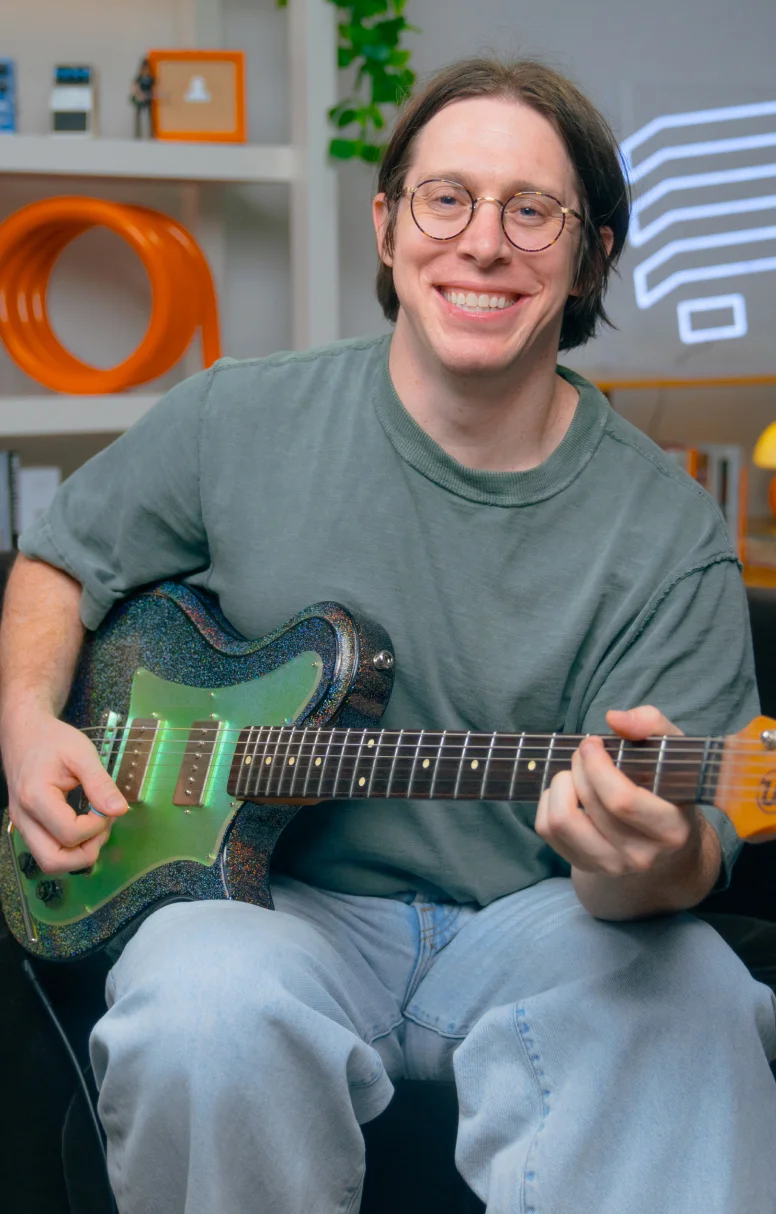
Seth Rosenbloom
Step up your blues game with a modern master. Get started with the blues in Seth's Bootcamp, level up in his Master Class, or dive into his lesson library to take your skills to new heights.
Explore LessonsLimitless learning.
All-inclusive access to every instrument and course.







FULL REFUND, NO QUESTIONS ASKED
Improve your playing or get your money back
We’re so confident that we can improve your playing that we’re underwriting your membership with a 60-day satisfaction guarantee.
Frequently asked questions

The most structured approach to learning music