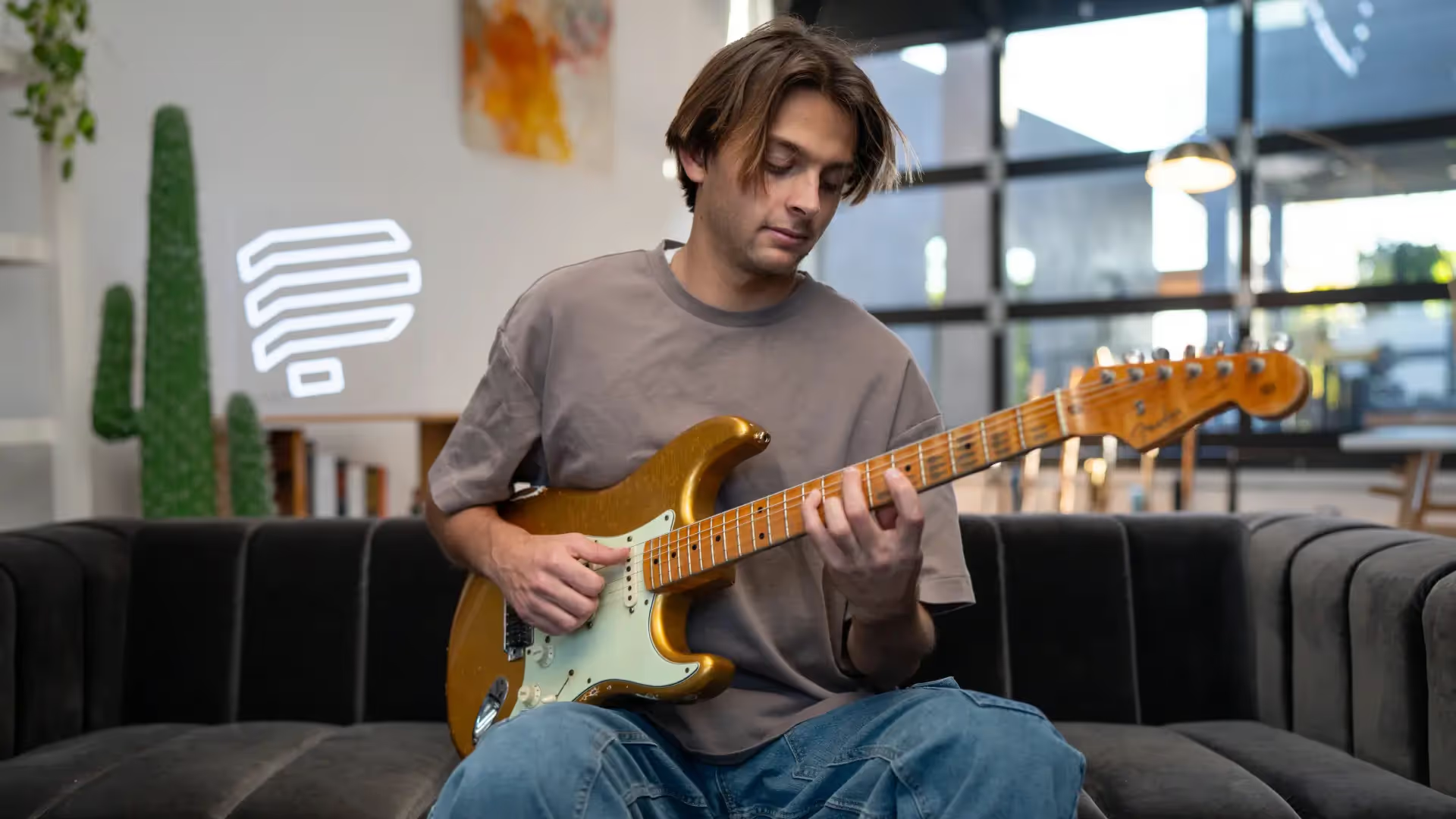
Step inside the melodic world of Eric Johnson’s signature style.
Advanced guitarists
If you're a fluent lead guitarist looking to add a melodic prog sound to your playing, this class is for you.
10 days
Kyle will guide you through 10 days of step-by-step instruction with daily practice plans and assessments.
Step up your soloing
You’ll leave this class with a new toolkit of prog-rock–inspired sounds you can use to blend Eric Johnson’s style into your own playing.
Take the next step
Once you've mastered this challenge, keep learning with more advanced Challenges and guided Learning Pathways.
Each day, Kyle Blackman breaks down a concept or technique at the core of Eric Johnson's iconic style. By the end of this class, you'll have a treasure trove of new chordal and improvisational skills inspired by one of the greatest rock guitarists of all time.

Stay focused with this step-by-step learning program designed by our expert team of music educators.
In this 10-day Challenge, Kyle will help you break out of habits that are holding you back. From spread triads and arpeggios to sweep picking and phrasing techniques, you'll learn how to apply Eric Johnson's classic moves in your own playing.

We’ll kick off the Challenge by exploring spread triads: one of Eric Johnson’s favorite tools for accessing an expansive sound.
You’ll learn how to spread your chord shapes across the fretboard and dial in your tone for maximum clarity.
From there, you’ll combine these chordal ideas with the pentatonic scale to expand your soloing vocabulary.

Eric Johnson’s picking approach is the engine behind his fast and fluid sound. In this section, you’ll build the control and consistency needed to move cleanly across the strings.
Then, you’ll apply that foundation to "playing the changes" by combining arpeggios with pentatonic shapes inside the CAGED system.

Two-note-per-string (2NPS) ideas are a powerful way to build speed and connect the fretboard. They’re also a key part of Eric Johnson’s fluid sound.
After you work through a series of 2NPS licks, we'll shift focus to phrasing. This conceptual lesson on how Eric Johnson approaches melody creation will help you blend what you're learning into your own playing style.
Explore open and closed triads the way Eric Johnson uses them. In this lesson, you'll turn simple chord shapes into melodic, voice-led ideas that expand your fretboard and harmonic vocabulary.
This lesson brings together everything you’ve worked on. You’ll learn a performance inspired by Eric Johnson’s legendary instrumental Cliffs of Dover, drawing on the melody, chordal movement, pentatonic fluency, and compositional approach that make the original so iconic.
Enter the diminished realm. These chords might sound intense at first, but they’re more approachable than they seem, and they’re a key part of Eric Johnson’s harmonic language.
For your final challenge, you’ll bring everything together combining the soloing, harmony, and phrasing skills you’ve developed throughout the class. Using signature Eric Johnson–inspired ideas, you’ll take the next step toward capturing his sound in your own playing.
Days 1-2. Spread triads and pentatonic colors
Learn how to break up chords using wide-interval triad voicings and extension notes like the 6th. Then, rethink the pentatonic scale using these spread triads, as well as arpeggios and targeted color tones.
Day 1. The spread triad move
You’re probably familiar with triads, but Eric Johnson’s unique use of spread triads completely changes the sound and feel of these three go-to notes. Learn how moving the 3rd up an octave can help you outline chords with more style.
Day 2. Adding color to the pentatonic scale
Now, we’ll apply that spread-triad concept to the good ol’ pentatonic scale. When combined with wide intervals and a focus on color tones, this technique is revolutionary for improvising within the 5-note scale.
Days 3-4. Hone your speed and fly through arpeggios
To play as fast as Eric Johnson, you must study his careful approach to picking. Kyle shows you three approaches to picking that will make fast lines easier to handle. Then, you’ll use these approaches to outline chords like Johnson using sweep-picked arpeggios.
Day 3. Picking approach
Before you scale the Cliffs of Dover, you need the right tools. Kyle will guide you through the three essential picking techniques that Eric Johnson uses constantly: speed picking, sweep picking, and hybrid picking. You’ll also zoom in on how you hold the pick and where you pick.
Day 4. Outlining chords
Now that you have the speed down, you’ll study how Eric Johnson outlines chords using blazing arpeggios. We’ll use the C and D shapes of the CAGED system to build up to Johnson’s speed and precision.
Days 5-7. Master the fretboard
In these lessons, Kyle will show you three more vital concepts to master on your way to unlocking Eric Johnson’s sound: the use of two-notes-per-string pentatonic runs, careful phrasing, and creative chord voicings.
Day 5. Two-string groupings
Eric Johnson is best known for creating riffs that travel the fretboard at lightning-fast speeds. His secret? Playing pentatonics horizontally along two or three strings. Kyle shows you how to apply this concept to navigate the entire fretboard cleanly and quickly.
Day 6. Phrasing
If a solo is a conversation, phrasing is the creation of the musical sentences that contribute to the bigger picture. You’ll learn how Johnson uses octaves, unexpected notes, and the Mixolydian scale to craft his unique voice. These techniques will help you start shaping your own tone.
Day 7. Common chords
While Johnson is best known for his lead tone, the other half of his playing is made up of interesting chord voicings and a crystal-clean tone. Kyle will guide you through spreading out your triads and adding extensions like the 9th, as well as using simple triads to harmonize the melody.
Days 8-10. Cliffs of Dover and other Johnson moves
In these final lessons, you’ll dive deeper into the creative mind of Eric Johnson through studying his Grammy Award-winning song Cliffs of Dover. You’ll study his solo in the song, as well as his use of diminished arpeggios throughout the track. Finally, you’ll add some quintessential Eric Johnson moves to complete your technique toolkit.
Day 8. Cliffs of Dover
You’ve heard it. You’ve probably tried to play it. It’s Eric Johnson’s masterpiece and one of the greatest examples of expert guitar playing. That’s right! Today, Kyle is gonna walk you through some licks inspired by Johnson’s solo in Cliffs of Dover and discuss how to apply them to your own playing.
Day 9. The diminished arpeggio
Playing the diminished scale on guitar is so fun because it’s symmetrical and repeats across the entire fretboard. Eric Johnson uses the sound of the diminished scale to add tension to his solo in Cliffs of Dover. Kyle shows you how to play over these passing chords both in this song and your own playing.
Day 10. Classic Eric Johnson moves
To complete your Eric Johnson journey, you’ll study some more stylistic techniques that Eric Johnson has used throughout his career. These include five-note arpeggios, Hendrix-inspired bending, and writing licks that span three pentatonic positions.
Now that you’ve gotten all the tricks and concepts down, it’s time to apply them musically with three performance pieces all inspired by different Johnson classics, including SRV, Cliffs of Dover, and Manhattan. You’ll need all the skills from this class to master these challenging tunes.
REAL students
FULL REFUND, NO QUESTIONS ASKED
We’re so confident that we can improve your playing that we’re underwriting your membership with a 60-day satisfaction guarantee.

Your Instructor
Kyle Blackman
Take your playing to new heights with Kyle Blackman’s genre-spanning lessons focused on rethinking scales and developing show-stopping speed.
Explore LessonsAll-inclusive access to every instrument and course.

Are you a guitar, bass or piano player who feels like you haven’t made progress in a few months… years… or even decades?
You’re probably stuck in what’s called the ‘intermediate plateau’. This is very common and can be very frustrating.
What’s the cause? Well, it’s pretty easy to learn the basics on any instrument. Learn a few chords and you can play hundreds of other songs. Learn a couple of scales and you can play some lead.
But what then? Triads? Modes? Arpeggios? The phrygian scale?!
Without a clear plan and learning system you fall back to playing the same things over and over again. Or you bounce around free lessons online but nothing seems to stick. It’s a recipe for a lot of practice without much progress.
That’s where Pickup Music can help. We specialize in taking players stuck in a rut and turning them into advanced musicians.
We do this through Learning Pathways that take you on a step-by-step journey towards mastery. We give you a highly structured system that shows you exactly what to work on each week to make serious progress.
These Learning Pathways take the guesswork out of your practice routine. You are guided through a proven grade-by-grade system with daily lessons, play-along practice exercises and interactive workouts.
But it’s not all about theory. We apply everything you learn to real music. That’s why every grade of our Learning Pathways build up to performing a song with a live backing band. This simulates what it’s like to play a real gig, with real musicians. It’s the absolute best way to learn.
You can also get 1-on-1 video feedback on your playing from our expert coaches and can attend weekly live lessons. This personal feedback makes Pickup Music the closest thing to taking in-person lessons, but at a fraction of the cost.
So does this method actually work? Will you see results in your playing?
The most common thing we hear from new members is that they’ve made more progress with Pickup Music in a few months than in years of teaching themselves. As one member recently told us, “I'm finally seeing progress for the first time in many years”.
Want to hear about other members’ experiences with us? Read our independent Trustpilot reviews.
Private music lessons cost about $50 per lesson or $2,600 a year.
Enrolling in a music academy costs about $40,000 a year.
A Pickup Music membership costs just $180 for the whole year. That works out to 50 cents a day!
But it’s not just about the money. It’s about not wasting your precious time. It’s about making actual progress as a musician.
By following our proven Learning Pathway system, you will eliminate the guesswork so you know exactly what you need to focus on each day and week to make lasting progress as a musician.
Most online music lesson sites are good at teaching one-off songs. Or they get super famous artist to record one-hour video lessons talking at length about their particular style and career.
The problem is that these 'infotainment' approaches don't stick. They don’t help you to actually get better as a musician. You can waste a lot of time bouncing around these types of unconnected, one-off lessons.
Pickup Music takes a different approach. We give you a highly structured system that shows you exactly what to work on each week to make serious progress. We take you beyond the basics through a step-by-step journey towards mastery.
By following a Pickup Music Learning Pathway, you are getting the most guided way to learn music. Over 6 grades, you are taken through daily lessons and practice exercises that carefully explain what’s going on behind the music.
Each grade then builds up to song performances that apply everything you’ve learned with a live backing band. These challenges - where we simulate what it’s like to play a real gig, with real musicians - is the absolute best way to learn.
You can also get 1-on-1 video feedback on your playing and weekly live lessons. This personal feedback makes Pickup Music the closest thing to taking in-person lessons, but at a fraction of the cost.
Want to hear about other members’ experiences with us? Read our independent Trustpilot reviews.
Everything on Pickup Music is designed to be taken on-demand and at your own pace. There are no deadlines, so you can work at your own speed. You can stay on a topic until you really understand it before you move on.
While we divide our Learning Pathways into ‘days’ - this is a suggestion only. Some learners might take a few days in one sitting, while others will spend a few sessions on a single day. You can go at the pace that feels most comfortable to you.
Canceling is easy. It’s just a click of a button on your account page.
You won't be charged anything if you cancel during your free trial. We also send you a reminder before your trial ends so you don’t accidentally forget about it.
If you cancel after your trial, you won't be billed again at your next billing cycle. Your membership will remain active until it expires on the day it was originally set to renew.
In addition to the free trial, we also offer a 60-day money back guarantee for first time customers who sign up via our website. If you’re not satisfied with your progress in the first 60 days of your membership, we will give you your money back - no questions asked.