Metal Learning Pathway
The ultimate guide to getting started with metal guitar


Intermediate
For guitarists with an intermediate level of rhythm and lead skills who are looking to explore the world of metal.
3 months
MYRONE will guide you through 6 grades of instruction with daily practice plans and assessments.
Confident shredder
Learn how to shred solos, lock in with iconic rhythms, and develop a rock-solid foundation in metal guitar.
Take the next step
Keep progressing with unlimited access to all of Pickup Music's Learning Pathways and lessons.
What you'll learn
Join MYRONE as he shows you how to navigate your shredder's journey and turn into confident metal guitarist.
- Learn how to craft your own metal riffs and solos.
- Develop fundamental rhythm & lead techniques.
- Hone your picking skills to start playing FAST.

.avif)
Curriculum
Stay focused with this step-by-step learning program designed by our expert team of music educators.
Grade 1. Metal Fundamentals
The sounds of metal guitar are closer than you might think. To kick off the Learning Pathway, MYRONE will show you how to use techniques and concepts you already know to quickly get a metal sound in your playing.

We're with you every step of the way in this Learning Pathway. In every lesson, MYRONE will break down a new concept and run through guided practice exercises with you so you can lock it into your muscle memory. To cap off each day's work, you'll put what you learned in a musical context with an interactive jam session.
Day 1. Power chords
The #1 essential building block for heavy metal music is the power chord, consisting of only two notes: the root and the fifth. To kick off the course, you'll learn to unleash the power of this uniquely stable chord form that's built for speed. 😈
Day 2. Scale-based riffs
If you want to write killer riffs and improvise epic solos, you’ll need scales to soar over your power chords. In this lesson, you’ll learn how to construct E minor riffs starting at the seventh fret.
Day 3. The “home base” shape
Soloing like MYRONE is going to be easier than you think. It’s all about creating a “home base” from which your guitar solos can originate. For many of us guitarists, that oasis of comfort is the minor pentatonic shape. You'll explore that here in Day 3.
Day 4. Diagonal octaves
Today is about taking your new foundation and seeing how easy it is to move across the fretboard. You'll learn how to get extra mileage out of Day 3's melody by diagonally moving it up the octaves.
Day 5. Introduction to arpeggios
If you’ve been awe-struck by the classically inspired shredding of Randy Rhoads, Yngwie Malmsteen, or Jason Becker – today is for you. Here, you'll learn arpeggios – a fantastic way to add sophistication to your metal riffs and solos. They’re the natural melodic evolution from the comforts of your home base.
Day 6. Clean tone in metal
In this lesson, you’ll get valuable perspective on the presence and importance of clean tone in metal music While metal is known for being loud and aggressive, it's essential to create contrast within your music – this is where clean tones come into play.
Day 7. Workout
The mega-track in this lesson will help you gauge your progress by calling upon your newfound metal foundations.
Performance pieces
Learn songs that put the techniques and concept you learned into a purely musical context. You'll even get to play along with a live-recorded metal band as your backing track.
Get feedback
Upload a video of yourself playing a performance piece for 1:1 video feedback from our team of professional guitarists.
Final quiz
Make sure you're ready for Grade 2.
Grade 2. Picking-Hand Technique
With your essential metal foundation forged, you'll sharpen your picking skills in Grade 2. Here, you'll dive into essential techniques like picking angles, downpicking, chugging, sweep picking, and more.
Day 1. Picking angles
The way you hold that little piece of plastic is crucial, it’s responsible for: Attack, timing, speed, and tone. When you first start playing guitar, these nuances aren’t a priority but as you progress, they become more important. Today, we’ll give your pick grip a full metal makeover.
Day 2. The chug
Palm muting is a common guitar technique in most genres, but metal takes it to the extreme. Thrash metal bands popularized this thick, heavy, rhythm sound back in the 80s. Since then, the chug has spread throughout the metal world. Even the ‘djent’ sound made famous by Meshuggah is just an extension of the humble chug. Today, you’ll dive deep into chug land.
Day 3. Downpicking
Up the intensity of any relentless riff with downpicking. Efficiency and ergonomics are great, but in metal, power takes priority. For those of you who favor alternate picking, this approach may seem a little alien – but trust us, there’s a method in the madness.
Day 4. Galloping
Legendary knights of the metal realm such as Deep Purple and Iron Maiden popularized this rhythm style. In Day 4, you’ll dive deep into galloping, thundering triplets to add a sense of urgency to your playing.
Day 5. Alternate picking
So far we’ve explored how different picking styles impact the sound or feel of a riff. Today is focused on one important factor – speed! You may be able to achieve a decent burst of speed with downpicking, but maintaining a rapid pace for an entire song (or show) isn’t happening. Alternate picking provides an ergonomic and efficient alternative.
Day 6. Sweep picking
When you need more speed and more notes across more strings… get your broom out 🧹 In this lesson, you’ll fulfill your need for speed with sweep picking. Sweep picking lets you play wide, fluid arpeggios with minimal effort from the picking hand. The main challenge is to get your left and right hand to move perfectly in sync.
Day 7. Workout
The mega-track in this lesson will help you gauge your progress by calling upon your new metal picking skills.
Performance pieces
Learn songs that put the techniques and concept you learned into a purely musical context. You'll even get to play along with a live-recorded metal band as your backing track.
Get feedback
Upload a video of yourself playing a performance piece for 1:1 video feedback from our team of professional guitarists.
Final quiz
Make sure you're ready for Grade 3.
Grade 3. Fretting-Hand Technique
Now, Myrone will help you develop your metal vocabulary and bring it to life with expressive techniques.
First, you'll focus on hexatonic scale patterns to inject new colors into your playing. Then, you'll explore how legato technique can glue it all together and give you a major speed boost.
Day 1. Introduction to hexatonic scale patterns
It’s time for your fretting hand to catch up with your picking hand – and that means learning THE scale. Today, you’ll start your journey to climb the hexatonic scale pattern mountain.
Day 2. Hexatonic scale patterns
By this point in the pathway, you’ll already have three options to play the E minor scale. Today, you’ll complete the whole set.
Day 3. Hexatonic octave patterns
Today, we’ll finally honor the ‘hex’ of hexatonic. You’ll learn how to navigate the fretboard diagonally using groups of six notes.
Day 4. Legato: Hammer ons
The next three days will quench your thirst for speed. Picking can only take you so far, so in order to set your licks on fire, you’ll need to involve legato techniques. First up: Hammer ons.
Day 5. Legato: Pull offs
If hammer ons rise into the sky like flames, pull offs are like waterfalls. You want your licks to rush down. Today, you’ll learn how to play a scale descending with the same ferocity as you do when ascending.
Day 6. Legato
Scales… You might be tired of them by now, but rest assured, all this practice will pay off when you’re nailing furiously-fast licks in the future. Today, you’ll combine hammer ons and pull offs to play a pattern.
Day 7. Workout
The mega-track in this lesson will help you gauge your progress by calling upon your new metal fretting-hand skills.
Performance pieces
Learn songs that put the techniques and concept you learned into a purely musical context. You'll even get to play along with a live-recorded metal band as your backing track.
Get feedback
Upload a video of yourself playing a performance piece for 1:1 video feedback from our team of professional guitarists.
Final quiz
Make sure you're ready for Grade 4.
Grades 4, 5, & 6
Finally, you'll continue building on your lead and rhythm skills with essential metal techniques for soloing and riffing. You'll also explore major metal subgenres and learn how to recreate the sounds that define them.
Grade 4. Lead Skills
This grade is a ton of fun. It's all about spicing up your new soloing skills with iconic metal techniques.
Day 1. Tapping
Tapping is an iconic technique that’ll give your playing some serious flair. Though you might think of it as a party trick, its spot has been cemented in the hall of metal fame by many a shredder. Today, you’ll dive into tapping.
Day 2. Guitar harmonies
Harmonies are as old as time itself, and, much like Ozzy, have survived against all odds. No genre showcases dual guitar harmonies quite like heavy metal. Bands like Thin Lizzy and Iron Maiden put them front and center. They built entire songs around this powerful sound. Today, you’ll learn to shred in stereo.
Day 3. Harmonics
There are secret pitches hidden within our strings. You may already be familiar with those natural harmonics found on the 12th, 7th, and 5th frets Some people even use them to tune up their guitar. However, did you know you can generate a series of harmonics for any fret using a special picking technique? Today, MYRONE will show you how to conquer harmonics.
Day 4. Pedal point
Feeling classy? Add some sophistication to your solos with this neo-classical technique.
Day 5. Tremolo picking
We covered alternate picking on Day 2, so you’ll be well prepared for the mechanics of tremolo picking when you get here, but there’s a distinct difference between these two concepts. Alternate picking is a foundational technique and is used frequently. Tremolo picking is a decorative technique used to play a rapid string of repeating notes.
Day 6. String skipping
Here, you’ll explore string skipping, which will enable you to play large octave jumps without moving up or down the neck, more intense percussive arpeggios, and interesting licks with unusual note groupings.
Day 7. Bonus lesson: Whammy 101
This last lesson depends on your guitar – a floating bridge is necessary for these techniques. If you have one, MYRONE will show you how to pull off three killer whammy-bar techniques.
Performance pieces
Learn songs that put the techniques and concept you learned into a purely musical context. You'll even get to play along with a live-recorded metal band as your backing track.
Get feedback
Upload a video of yourself playing a performance piece for 1:1 video feedback from our team of professional guitarists.
Final quiz
Make sure you're ready for Grade 5.
Grade 5. Rhythm Skills
Get ready to chug your way through some seriously sick riffs.
Day 1. Open-string riffs in E
Now that your fretting and picking hands have acquired all kinds of fancy new skills, it’s time to put them to work and learn some common phrases.
Day 2. Open strings & power-chord riffs
Open E and A strings pack so much power, it’s no surprise that E and A minor are popular keys for metal riffs.
Day 3. Open-string riff with thirds
Today features a fun variation for the harmonically-minded shredder: Combine an open string with thirds on top.
Day 4. Riffing with octaves
By now, you’ll have caught on to the fact that metal guitarists don’t work harder, they work smarter. When we take these classic riffs apart, the ingredients are simple but effective. Today, you’ll look at another “trick”: Adding octaves to a riff.
Day 5. Drop-D tuning
You’ve learned how to utilize the open E string. Turns out that tuning it down to D sounds even grittier. Drop-D is one of the most common alternate tunings and is used in all kinds of genres – we’ll dive deep into it in Day 5.
Day 6. Slides
You probably know how to slide, but can you make your slides metal? Jazzcats slip into a note from a half-step below, blues players might cover a few more frets, and metal guitarists go all the way. You’ll learn slides the metal way in Day 6.
Day 7. Pinch Harmonics in Rhythm
Today, you’ll apply one more concept from an earlier grade – pinch harmonics – to a rhythm part.
Performance pieces
Learn songs that put the techniques and concept you learned into a purely musical context. You'll even get to play along with a live-recorded metal band as your backing track.
Get feedback
Upload a video of yourself playing a performance piece for 1:1 video feedback from our team of professional guitarists.
Final quiz
Make sure you're ready for Grade 6.
Grade 6. Metal Genres
So many styles, so little time.
Day 1. Thrash metal
Young musicians will always try to find ways to push the boundaries and up the intensity of what came before – thrash metal is a perfect example of this. The founding members of Metallica were in their teens when they started. They wanted to make an impact in a big way and ultimately became one of the biggest thrash metal bands in the world. Today, you’ll learn all about the style and explore how to capture some iconic thrash sounds in your playing.
Day 2. Groove metal
Everybody loves to groove – even metalheads. Yessterday we looked at thrash, which is pretty rigid – all the beats and notes feel synchronized. Groove metal, on the other hand, takes things in a looser rhythmic direction – more syncopated. In Day 2, you’ll get your groove on – metal style.
Day 3. Nu metal
In the 2000’s musical subcultures began to intertwine – nu metal welcomed elements from hip-hop and electronic music into the mix. Today, you’ll explore clean chords and swelling lead lines in the nu metal style.
Day 4. Metalcore
Dramatic dynamic shifts, massive breakdowns, a TON (arguably too many?) halftime drum parts. It could only be metalcore. In Day 4, that’s exactly what you’ll explore.
Day 5. Prog metal
Buckle up, it’s time to get progressive. Progressive rock/metal aims to take an unorthodox approach to composition using far-out musical concepts or forms. This usually manifests itself as unpredictable song structure, odd time signatures, and challenging instrumental sections.
Day 6. Power metal
Have you ever wondered what Judas Priest would sound like if J.R.R. Tolkien had written their lyrics? You don’t need to wonder – you just need to listen to power metal. In Day 6, you’ll explore power metal picking rhythms and riffs.
Day 7. Hair metal
Birthed from the glam metal scene in the 1980s its spiritual home was the Sunset Strip. This genre is about super over-the-top aesthetics in every way possible – big hair, neon guitars, and spandex onesies. Stadium anthems are the aim of the game here, hair metal fans love to chant a hooky chorus.
Performance pieces
Learn songs that put the techniques and concept you learned into a purely musical context. You'll even get to play along with a live-recorded metal band as your backing track.
Get feedback
Upload a video of yourself playing a performance piece for 1:1 video feedback from our team of professional guitarists.
Final quiz
Make sure you're ready for the next step in your guitar journey.

REAL students
Don’t take our word for it, take theirs
What guitarists love about this course

Your Instructor
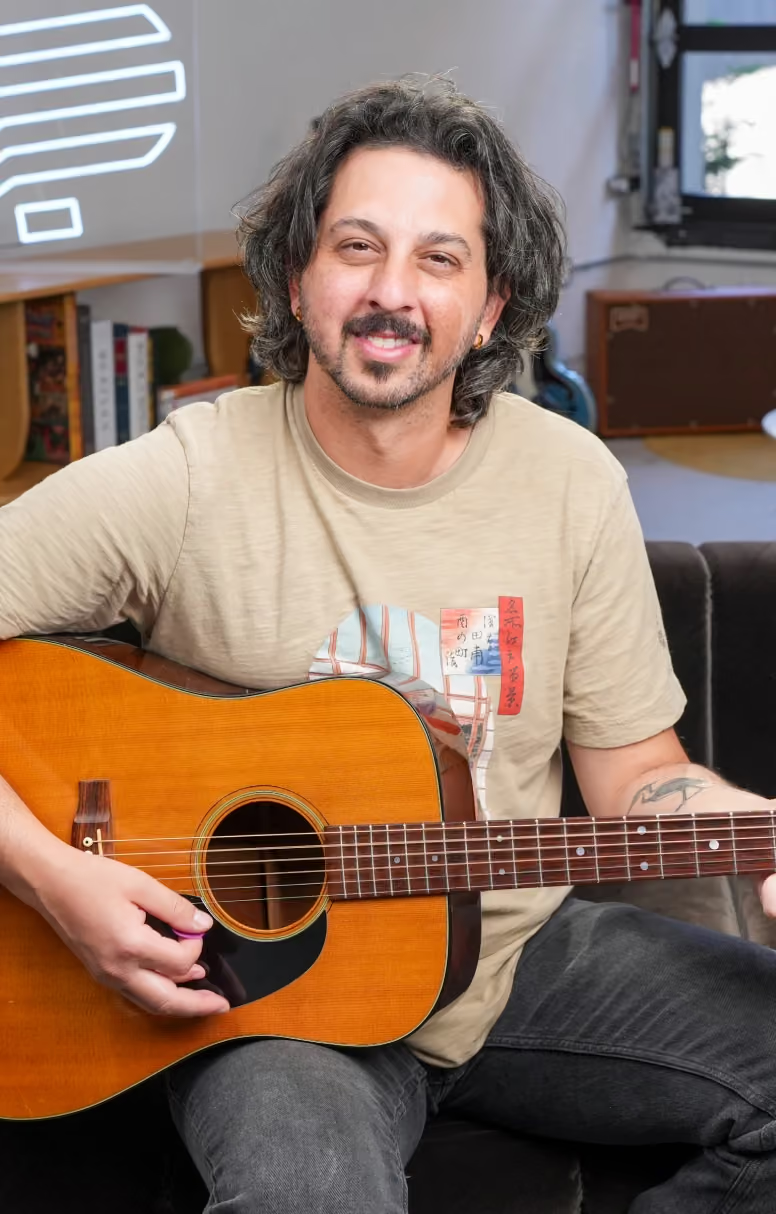
MYRONE
MYRONE is a master metal guitarist who's here to guide you through your shredder's journey.
Explore LessonsLimitless learning.
All-inclusive access to every instrument and course.








FULL REFUND, NO QUESTIONS ASKED
Improve your playing or get your money back
We’re so confident that we can improve your playing that we’re underwriting your membership with a 60-day satisfaction guarantee.
Frequently asked questions

The most structured approach to learning music