Music Theory Learning Pathway
Decode the music you love.


All levels
Whether you're a seasoned pro who learned by ear or complete beginner, this Learning Pathway is a game changer.
3 Months
Quentin will guide you through 6 grades of step-by-step instruction with daily practice plans and assessments.
Understand music
Transform the way you hear, play, and write music by mastering core theory principles through the lens of guitar.
Take the next step
Once you've mastered theory, keep progressing with advanced Master Classes and guided learning paths.
What you'll learn
Who said theory had to be confusing and boring? This Learning Pathway will transform how you play and write music.
- No prior music theory knowledge needed.
- Keep the focus on music – apply everything you learn to your guitar with daily guided practice exercises.
- Analyze real songs from a diverse selection of artists like the Beatles, Post Malone, and many more.

.avif)
Curriculum
Stay focused with this step-by-step learning program designed by our expert team of music educators.
Grade 1. Music Theory 101
Get a gentle introduction to music theory by zooming way in and way out on the core principles of music.

Overview
Join your mentor Quentin as he guides you through the basic tenets of music. This is Music Theory 101.
Day 1. What is music and pitch?
Define music and break it down into four core elements.
Day 2. Timbre
Learn about the uniqueness of sound.
Day 3. Duration and Rhythm
Learn about the fundamentals of pulse and meter.
Day 4. Intensity/Dynamics
Learn how changing intensity helps us tell a captivating musical story.
Day 5. Texture and instrumentation
Learn how various musical elements combine to create texture.
Day 6. Form
Learn how a song is organized and analyze your favorite tunes.
Day 7. Genre
Learn the characteristics of various genres.
Day 8. 12 TET
Learn about the tuning system we use in Western music.
Day 9. Finding notes on the Piano
Learn about the tuning system we use in Western music.
Day 10. Finding notes on the Guitar
Apply your piano note-name knowledge to guitar.
Day 11. Tonality
Learn about the aural difference between major and minor keys.
Day 12. Introduction to the Major Scale
Learn the ins and outs of the most important scale in Western music.
Day 13. The natural Minor Scale
Learn how to derive the natural minor scale as a major scale mode.
Day 14. Recap
Review what you learned and pass a series of tests to make sure you're ready for Grade 2!
Grade 2. Harmony and Rhythm Fundamentals
Grade 2 is where the work really begins! You’ll leave this level with a rock-solid foundation for rhythm and chord progressions.
Overview
This level of the Learning Pathway is all about chords and rhythm. Over the next 13 days, you’ll gain a thorough understanding of these fundamental concepts, learn how they’re used in popular music, and apply them to your own playing.
Day 1. What are Chords?
Gain a deeper understanding of the construction and function of chords.
Day 2. Intro to the Numbers System
Get acquainted with the numbers system – an essential tool you’ll use to identify and play chord progressions.
Day 3. The Numbers System (Continued)
Continue to learn the ins and outs of the numbers system – an essential tool for musical communication and analysis.
Day 4. Applying Triads to the Guitar
Learn how to add spice and color to basic triads.
Day 5. Intro to Seventh Chords
Get started with seventh chords – a colorful and versatile chord shape.
Day 6. Changing Keys and Finding Tonalities
Learn how to transpose music to a new key and distinguish between major and minor keys.
Day 7. Common Chord Progressions
Gain a deeper understanding of songwriting theory by examining case studies of common chord progressions in popular music.
Day 8. Original Progressions
Fuel your songwriting by developing the skills needed to compose original chord progressions.
Day 9. What is Rhythm?
Get acquainted with the fundamental music theory of rhythm – the most important element of music.
Day 10. Whole, Half, and Quarter Notes
Learn the basic theory of fundamental rhythmic subdivisions.
Day 11. Eighth and Sixteenth Notes
Explore more rhythmic subdivisions by learning the theory of eighth and sixteenth notes.
Day 12. Triplets
Learn the theory of the most complex subdivision yet – triplets.
Day 13. Case Studies
Fuel your songwriting skills by analyzing the harmonic structure of iconic songs.
Grade 3. Decoding Chord Progressions
In this grade, you'll take a deep dive into major-key chordal concepts to fuel your rhythm playing and songwriting.
Overview
Over the next 13 days of instruction, you’ll learn to create chord progressions in any key and identify the theory behind songs with only your ears.
Day 1. Review of the Numbers System
Get a refresher on every songwriter's best friend – the numbers system.
Day 2. Scale-Tone 7ths
Learn how to color in your major-key scale-tone chords with 7th-chord voicings.
Day 3. Lead Sheets and Roman Numeral Analysis
Get acquainted with the basic architecture of a lead sheet and start analyzing songs using the numbers system.
Day 4. Chord Nomenclature and Slash Chords
Develop an understanding of how to name chords and learn how to incorporate colorful bass notes in your chords with slash chords.
Day 5. Circle of 5ths
Study the circle of 5ths to better analyze and understand the movement of chord progressions.
Day 6. Formula for All 12 Keys
Learn how to determine the sharp and flat notes for all 12 keys.
Day 7. Numbers to Chords Practice
Start honing your ability to translate numbers system progressions to chord names.
Day 8. Chords to Numbers Practice
Reverse yesterday's process to adapt a chord progression into the language of the numbers system.
Day 9. Roman Numeral Analysis
Learn how to understand and recognize patterns in numbers system chord progressions.
Day 10. Case Studies
Analyze iconic songs through the lens of the numbers system.
Day 11. Case Studies (Part II.)
Continue analyzing the chord progressions of iconic songs.
Day 12. Aurally Recognizing Chords
Learn how to identify the basic chordal movements in a song using nothing but your ears.
Day 13. Aurally Recognizing Chords (Part II.)
Continue training your ears to recognize chordal movements.
Grade 4-6 – Intermediate Rhythmic and Harmonic Concepts
Take your theory skills to the next grade with complex rhythms, industry-standard songwriting techniques and be able to write your own song.
Grade 4. Rhythm Deep Dive
This grade puts the spotlight back on rhythm – the most important (and often-overlooked) aspect of music. Over the next 14 days, you'll hone your theoretical understanding of and ability to play rhythm on guitar.
Day 1. Whole and Half Notes/Rests
Kick off the grade by further developing your understanding of fundamental subdivisions.
Day 2. Quarter and Eighth Notes / Rests
Continue developing your understanding of fundamental subdivisions by studying quarter and eight notes/rests.
Day 3. Sixteenth Notes/Rests
Speed things up and work on sixteenth-note subdivisions.
Day 4. Triplet Notes/Rests
Tackle the trickiest fundamental subdivision: triplets.
Day 5. Combinations and Practice I (Clapping)
Work on internalizing rhythmic subdivisions through clapping practice.
Day 6. Combinations and Practice I (Guitar)
Work on applying rhythmic subdivisions to your guitar playing.
Day 7. Combinations and Practice II (Clapping)
Continue internalizing rhythmic subdivisions through clapping practice.
Day 8. Combinations and Practice II (Guitar)
Continue applying rhythmic subdivisions on the guitar.
Day 9. Syncopation
Learn the fundamentals of how to dance around the beat.
Day 10. Hemiola
Learn how to apply this specific polyrhythm to your guitar.
Day 11. Time Feel
Gain a deeper understanding of what it takes to play with great rhythm.
Day 12. Metronome Tricks
Hone your rhythm skills with these fun exercises.
Assessments
Wrap up with a few assessments to benchmark your progress.
Grade 5. Harmony Deep Dive
In this grade, you'll explore advanced harmonic concepts and learn how to write beautiful chord progressions. Over the next two weeks, you’re going to learn a series of harmonic concepts that will seriously transform your compositional skills and chordal playing.
Day 1. Extensions
Learn how to add color to your chords through extensions.
Day 2. Perfect, Plagal, and Deceptive Cadences
Develop an understanding of how specific chordal movements can induce and resolve tensions within a chord progression.
Day 3. Relative and Parallel Minor
Learn how to transition from a major to a minor key within a song.
Day 4. Minor-Key Harmony
Further develop your harmonic foundation by exploring chords in a minor key.
Day 5. IV Minor
Get a quick songwriting technique under your belt by changing the tonality of the IV chord in a major-key progression.
Day 6. Harmonic Suspension
Explore how you can manipulate chords by “suspending” them for added tension and release.
Day 7. Diatonic Substitutions
Explore how to spice up your songwriting with reharmonization.
Grade 6. Songwriting Theory
In this grade you can put everything into practice what you've learned so far. This grade starts by analyzing famous songs of various genres to prepare you to write your own song in the second part of the grade.
Day 1. "Wait for the Moment" - Vulfpeck
Together we will analyze "Wait for the Moment" by Vulfpeck.
Day 2. "The Man Who Sold the World" - David Bowie
Together we will analyze "The Man Who Sold the World" by David Bowie.
Day 3. "Fly As Me" - Silk Sonic
Together we will analyze "Fly As Me" by Silk Sonic.
Day 4. "Something" - George Harrison
Together we will analyze "Something" by George Harrison.
Day 5. Ideate your song
Creative mode on! Draft three ideas for your very own song.
Day 6. Refine your song
Listen to your ideas from Day 5, select one and keep working on it.
Day 7. Submit your song
Finish up your composition and submit it to get personalized feedback from the Pickup Music team.

REAL students
Don’t take our word for it, take theirs
What guitarists love about this course

Your Instructor
Dr. Quentin Angus
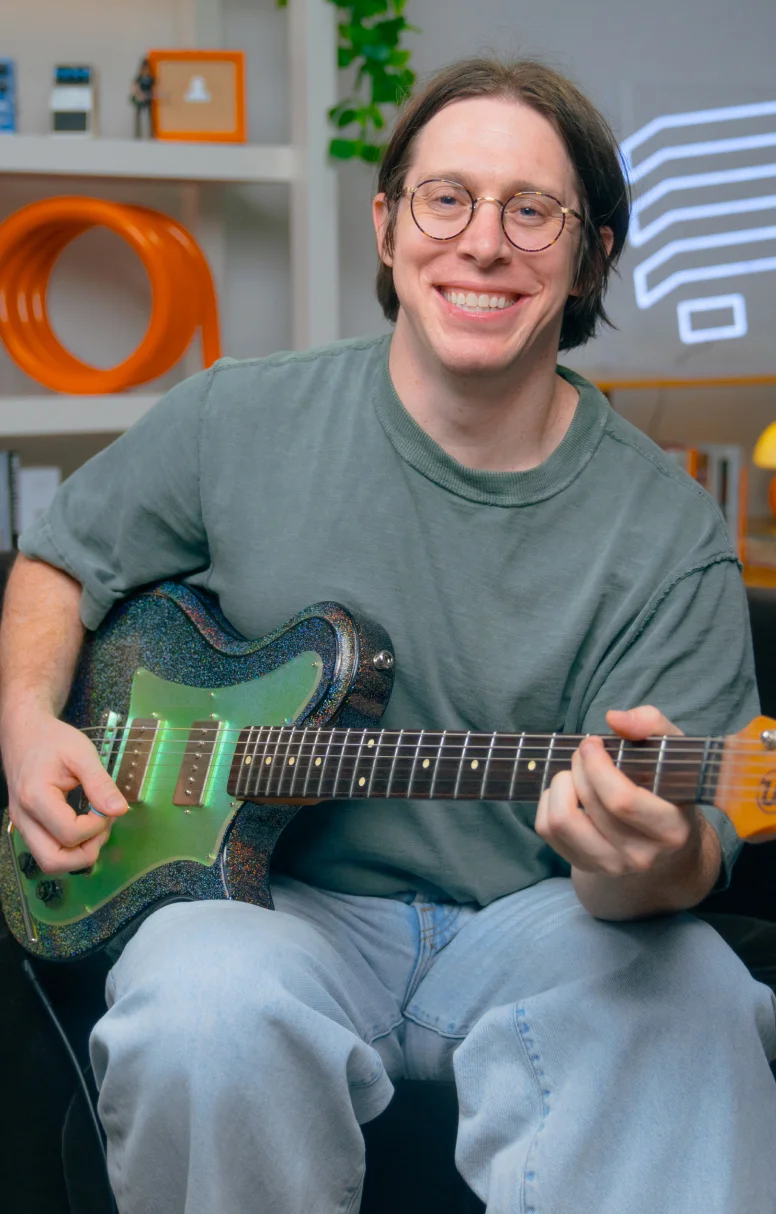
Dr. Quentin Angus is one of Pickup Music's most popular instructors. His lessons have helped hundreds of students demystify their fretboards with practical theory and navigate the complex world of jazz guitar.
Explore LessonsLimitless learning.
All-inclusive access to every instrument and course.








FULL REFUND, NO QUESTIONS ASKED
Improve your playing or get your money back
We’re so confident that we can improve your playing that we’re underwriting your membership with a 60-day satisfaction guarantee.
Frequently asked questions

The most structured approach to learning music