Beginner bassists
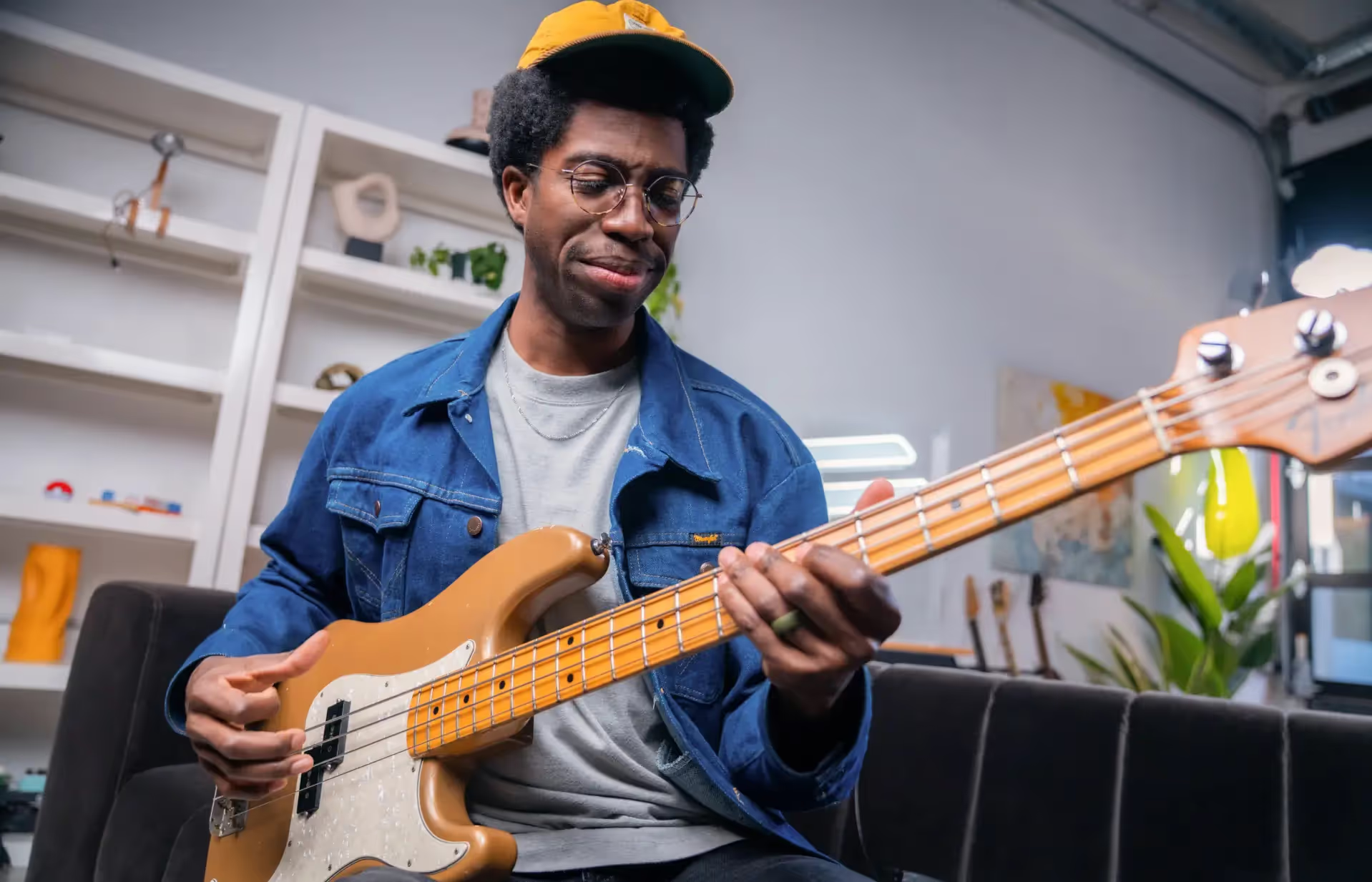
New to bass? You’re in the right place. This class is for total beginners. Grab your axe, and we'll show you how to groove.
3 months
Corbin will guide you through 6 grades of step-by-step instruction with daily practice plans and assessments.
Rock-solid fundamentals
You'll leave this pathway with a solid technical and rhythmic foundation to support your growth as a bassist in any genre.
Take the next step
Once you've mastered the bass-ics, keep progressing with intermediate classes and guided pathways.
What you'll learn
This pathway gives you everything you need to build a rock-solid bass foundation while keeping things fun and musical from Day 1.
- Learn the art of rhythm by grooving through real songs
- Build a foundation that'll set you up for success in any style
- Develop vocabulary to craft your own basslines
- Build proper technique to sidestep classic beginner pitfalls

Curriculum
Stay focused with this step-by-step learning program designed by our expert team of music educators.
Grades 1-2
Kick off your bass journey with the absolute fundamentals. Do you dream of playing in a band? Want to record music in your bedroom? Whatever your goals, the foundation you build in these first grades will set you up for a long life of bass enjoyment.

Grade 1. Fretboard Foundations
Your low-end journey begins here. To kick off the class, Corbin will run you through essential concepts and proper technique so you can avoid the pitfalls that slow beginners down.
Day 1. Getting started
Learn the different parts of the bass and how to hold your instrument comfortably. Begin finding your way around the fretboard to learn your first riff. That’s right, we said it. By the end of the day, you’ll know your bass better and how to play a bassline without tension.
Day 2. Note length and muting
Just as important as knowing how to play a note is knowing when to stop playing a note. In this lesson, you’ll learn how to mute your strings to control note length and emphasize the rhythmic nature of the bass.
Day 3. Groovin’ on the A string
Believe it or not, you’re ready to start preparing for a performance piece at the end of the grade. You’ll learn how to play on the A string and fret notes with your pinky finger. We’ll also go over essential plucking-hand techniques like where to anchor your thumb and how to pluck.
Day 4. Combining strings and reading TAB
As a beginner bassist, TAB will be vital for you to learn new basslines and write down your own ideas. Corbin will show you how to unlock thousands of songs through the magic of TAB. You’ll also work on moving from the E string to the A string efficiently.
Day 5. Groovin’ on the D and G strings
Learn how to play on the two remaining strings. Corbin will show you where to anchor your plucking-hand thumb to mute unwanted strings. He’ll also show you how to fret with your middle finger.
Day 6. Combining strings and how to practice
Now that you’re more comfortable with all four strings, it’s time to combine them. Then, Corbin will introduce you to the Pickup Practice System. Know what you’ll practice and understand your goals each time you sit down with your bass. This lesson will help you cultivate a healthy practice routine for years to come.
Day 7. Workout
Put those new calluses to the test with a fun workout designed to strengthen your rhythm skills and put everything from Grade 1 together. Pickup Music workouts make for great daily warmups.
Performance pieces
Choose a song to learn that takes what you worked on in Grade 1 and puts it in a musical context. Here, you'll get to jam with a live-recorded band of pro-LA musicians as your backing track.
Personalized feedback
Submit a video of yourself playing a performance piece from this grade for custom video feedback on your playing from our team of pro bassists.
Final quiz
Make sure you're ready to move on to Grade 2.
Grade 2. Intro to the Box
The bass fretboard is conveniently laid out in shapes or patterns. Perhaps the most important of these patterns is the box. This useful shape contains all the notes you’ll need to play thousands of songs. Corbin will guide you through building the box to play genres like blues and Latin jazz.
Day 1. R and 5
The box is the ultimate cheat code for the beginning bassist to unlock the fretboard, whatever genre you’re interested in. To start your box studies, Corbin will show you the R-5 move. This simple shape is all you need to start creating your own basslines today.
Day 2. R, 5, 8
Learn about the next most important note in the box: the 8th, or octave. This is the same note as your root, just moved up in pitch. Adding the 8 to your R-5 move will really expand your groove possibilities.
Day 3. Building out the box
Complete your box by adding the 4th and b7. These notes will help you keep the groove while adding harmonic complexity and emphasizing chord qualities.
Day 4. Box blues
With your box built up, you can now use it to cover different chords across a song, no matter the key. Corbin will show you how to apply the box to a standard 12-bar blues.
Day 5. Below the A string
Move your box shape up to the A string to unlock the 5th below (in pitch) the root and a new note: the 6th. You’ll use a Motown-inspired track to apply your A-string box and new notes.
Day 6. Latin jazz box
With our full A-string box fully filled, we can play some sweet basslines starting in any key. As further proof of how versatile the box is, we’ll apply it to a Latin jazz groove.
Day 7. Rhythm and counting workout
No better workout than boxing. But put those gloves away because we’re talking about the box on the bass. Corbin will guide you through a guided workout to review your new box knowledge.
Performance pieces
Choose a song to learn that takes what you worked on in Grade 2 and puts it in a musical context. Here, you'll get to jam with a live-recorded band of pro-LA musicians as your backing track.
Personalized feedback
Submit a video of yourself playing a performance piece from this grade for custom video feedback on your playing from our team of pro bassists.
Final quiz
Make sure you're ready to move on to Grade 3.
Grade 3. Styles and Grooves
In this grade, you’ll apply the fretboard fundamentals you’ve been working on to different styles: from funk and disco to Latin music and beyond. While exploring these iconic genres, Corbin will introduce you to a new set of techniques that'll further develop your rhythmic foundation.
Day 1. Open-string riffage
Give your fretting hand a break while adding more variety to your bassline with open strings. Corbin will also introduce you to the idea of counting and understanding rhythms.
Day 2. Disco vibes
Disco is a super funky dance genre. The bass in disco makes great use of octaves to create momentum and get those toes tapping.
Day 3. Starting riffs with the pinky
That’s a nice box you’ve built, but now it’s time for Corbin to show you how to step outside it. By starting a riff with your pinky, you change what’s called the scale position. This alters the whole approach to building basslines and seeing the fretboard.
Day 4. Funky vibes
There’s possibly no genre more bass-friendly than funk. That’s due in part to the prevalence of syncopation. Corbin will show you this rhythmic technique for playing offbeats and adding extra funkiness to your lines.
Day 5. ‘90s rock vibes
Learn how to create an infectious rock sound by locking in with the guitarist’s rhythm. Corbin will also show you how to play the same riff in different parts of the neck. This is a vital skill for any bassist because it lets you choose the right tone for each song.
Day 6. Latin vibes
Learn a bossa nova R-5 bassline to cap off Grade 3 lessons. Bossa nova is an extremely popular Brazilian genre that fuses pop and jazz chords with traditional Brazilian rhythms.
Day 7. Workout
Let’s pump up those bass biceps with a workout to test how well you’ve memorized the notes on your E string.
Performance pieces
Choose a song to learn that takes what you worked on in Grade 3 and puts it in a musical context. Here, you'll get to jam with a live-recorded band of pro-LA musicians as your backing track.
Personalized feedback
Submit a video of yourself playing a performance piece from this grade for custom video feedback on your playing from our team of pro bassists.
Final quiz
Make sure you're ready to move on to Grade 4.
Grade 4. Rhythm and Feel
No matter what level you’re at as a bassist, it’s essential to have a strong rhythm foundation. Grade 4 will introduce you to the tools and time signatures used by professional bassists in the studio and on the stage. By the end of these lessons, you’ll know the most important rhythms and how to apply them in almost any musical setting.
Day 1. The grid
To start off Grade 4, Corbin will help you understand the rhythms you’ve already been playing using the grid. This is one of the best ways to understand rhythms, and it’s used by producers and composers to create tight grooves and keep everyone in time.
Day 2. The sacred drum and bass relationship
As a bass player, you’re a member of the rhythm section, along with the drums. You’ll learn how to lock in with your rhythm partner by listening carefully to and playing with the drummer.
Days 3 and 4. Time signature
Besides 4/4 time, two of the most used time signatures in all of musical history are the 3/4 and 6/8 time signatures. From Mozart to John Mayer, these times have been used to create dreamy ballads with a waltz or shuffle feel. Corbin will guide you through the basics of these essential times.
Day 5. Swing feel
Learn how simple it can be to flip a groove on its head using the swing feel. Whether you’re playing jazz, neo soul, or pop ballads, adding a swing feel can give the track a laid-back vibe. Corbin will help you feel the difference between straight and swung 8th notes.
Day 6. Deeper into the grid
Yes, the notes you play are important, but just as important are the notes you don’t play. You’ll learn how these non-played notes (or rests) make your basslines more impactful.
Day 7. Workout
Your bass coach Corbin will help you lock in with the drummer while grooving on the A string. This one will really test your counting skills.
Performance pieces
Choose a song to learn that takes what you worked on in Grade 4 and puts it in a musical context. Here, you'll get to jam with a live-recorded band of pro-LA musicians as your backing track.
Personalized feedback
Submit a video of yourself playing a performance piece from this grade for custom video feedback on your playing from our team of pro bassists.
Final quiz
Make sure you're ready to move on to Grade 5.
Grades 5 and 6
You’ve laid a rock-solid foundation. Now, it’s time to start building on those skills and adding some color to your playing. In Grade 5, you’ll learn four must-know scales to craft melodic basslines and explore more of the fretboard. In Grade 6, you’ll learn intermediate techniques to add style and depth to your groove. By the end of these two grades, you’ll be well on your way to finding your unique voice as a bassist.
Grade 5. Expanding Your Fretboard
Mastering your fretboard is a major step on your bass journey. From outlining chord progressions to improvising basslines, there are so many useful skills that you unlock when you know your fretboard. Corbin will show you the most important scales and techniques to unlock fretboard freedom.
Day 1. Slides
Before you master the fretboard, you gotta learn how to traverse it with style. Slides help you add more interest to the way you arrive at notes. Corbin will show you how to add slides to your bass arsenal.
Day 2. Major scale
Regardless of what instrument you play, the major scale is the most important scale to know. Learning it lets you write your own lines and understand how harmony works. Don’t be intimidated by the theory, though. It’s just seven notes, and Corbin breaks it down into an easy-to-remember formula.
Day 3. The major triad
Bassists don’t tend to play whole chords like guitarists do. Instead, they play single notes that outline chords. In this lesson, you’ll learn the essential building block of chords: the triad. With just these three notes, you’ll be able to outline major scales with precision.
Days 4 and 5. Pentatonic
The major and minor pentatonic are must-know scales that contain just five notes and will serve you in nearly any musical situation. Corbin will show you how to play the major scale using an easy system we call the 3:2 system.
The minor pentatonic fits nicely in our box, and all you’ll do is move the 3rd down one fret. This is a great scale to play over minor chords, as well as dominant 7th chords.
Day 6. Approaching the root
The root is arguably the most important note we can play, so we want to make it as impactful as possible. Corbin will show you how to lead into it with approach notes for maximum impact.
Day 7. Workout
Your toned bass coach Corbin has got another workout for you. Review your scales and triad shape, then test how well you know your D-string notes.
Performance pieces
Choose a song to learn that takes what you worked on in Grade 5 and puts it in a musical context. Here, you'll get to jam with a live-recorded band of pro-LA musicians as your backing track.
Personalized feedback
Submit a video of yourself playing a performance piece from this grade for custom video feedback on your playing from our team of pro bassists.
Final quiz
Make sure you're ready to move on to Grade 6.
Grade 6. Bass Techniques
You’ve got all these notes, now learn how to give them character with techniques that help you rise above the beginner crowd. Corbin will introduce you to ghost notes and slides, as well as pick-playing and hammer-ons. The skills you learn in this grade will help you make your basslines unique.
Day 1. The swoosh
The swoosh is a go-to move when you want to mark an important part of a song, such as the beginning or start of a new section. You’ll learn how to use the swoosh in moderation to add flair to a song without sounding corny.
Day 2. Intro to ghost notes
Add personality to your basslines with ghost notes. These semi-muted notes add rhythmic expression without pitch, so they work almost anytime and anyplace.
Day 3. Hammer-ons
Give your plucking hand a brief break with hammer-ons. These help you play faster and more smoothly, and they just sound awesome. Corbin will show you how to implement them in your playing to add even more flavor.
Day 4. Bass players can play the melody too!
While we bassists are a key part of the rhythm section, we can sneak in melodies from time to time. Learn how to know when to step out and play a melody. You’ll be moving up to a higher register for this lesson.
Day 5. Neo-soul thumb
R&B fans, this is the lesson for you! Corbin will show you how to get that warm and tubby tone synonymous with neo soul. You’ll learn how to mute with your palm and pluck with your, you guessed it, thumb.
Day 6. Playing with a pick
Many bassists prefer to use only their fingers, but the truth is that there are genres that cannot be properly played without a plectrum. Corbin will help you learn this cool-looking technique to achieve a driving sound and become a well-rounded bassist.
Day 7. Workout
For your final workout of the pathway, you’ll review ghost notes and hammer-ons while focusing on learning the notes on the G string.
Performance pieces
Choose a song to learn that takes what you worked on in Grade 6 and puts it in a musical context. Here, you'll get to jam with a live-recorded band of pro-LA musicians as your backing track.
Personalized feedback
Submit a video of yourself playing a performance piece from this grade for custom video feedback on your playing from our team of pro bassists.
Final quiz
Make sure you're ready to move on to new challenges.


Your Instructor
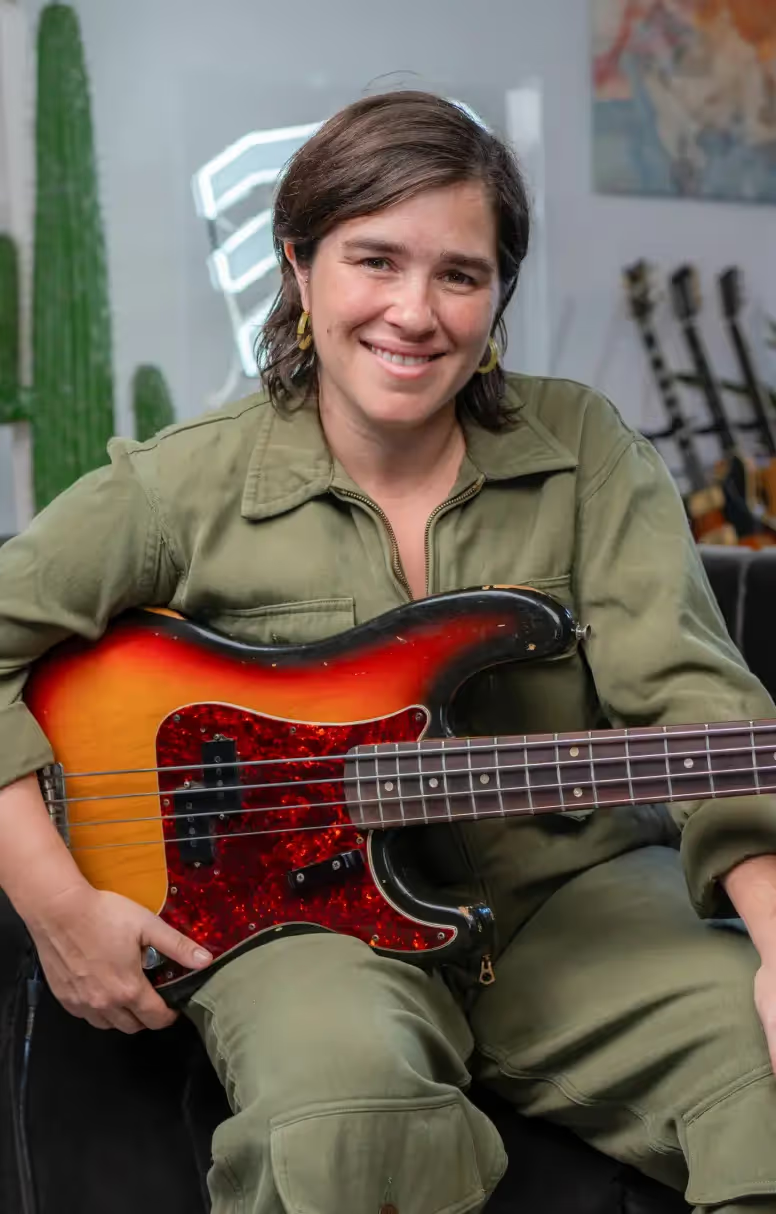
Embark on a journey to low-end mastery by learning fundamental skills from one of the hardest working bassists in the biz.
Explore LessonsLimitless learning.
All-inclusive access to every course.






FULL REFUND, NO QUESTIONS ASKED
Improve your playing or get your money back
We’re so confident that we can improve your playing that we’re underwriting your membership with a 60-day satisfaction guarantee.
Frequently asked questions

The most structured approach to learning music