Intermediate Learning Pathway
Become a versatile and confident bassist.


Intermediate bassists
Playing for a while but feel like you’re stuck in a rut? This class will reignite your passion for the bass and help you unlock new levels of creativity.
3 months
Corbin will guide you through 6 grades of step-by-step instruction with daily practice plans and assessments.
Unlock your bass potential
You'll leave this pathway with the skills to anchor any rhythm section, build tasteful basslines, and navigate your fretboard with ease.
Take the next step
Once you've mastered the concepts in this class, keep progressing with advanced challenges and guided pathways.
What you'll learn
This class gives you the tools to break free from boring basslines, expand your sound, and move past the intermediate plateau.
- Unlock your entire fretboard
- Tackle advanced techniques and grooves
- Study the moves & vocabulary of iconic players
- Learn how to lock in with the rhythm section


Curriculum
Stay focused with this step-by-step learning program designed by our expert team of music educators.
Grade 1. The 5 T’s
It’s time to take your bass playing to the next level and break out of the intermediate plateau. Corbin will share with you the most essential skills for advancing right away: the 5 T’s. The skills you learn here will stay with you throughout your entire bass-playing journey.

Day 1. Touch
Touch is undoubtedly the most important of the 5 T’s. To start honing your touch, you’ll focus on controlling your dynamics and muting. Getting Touch locked in is essential for true bass mastery.
Day 2. Time
In this lesson, Corbin will guide you through rhythmic fundamentals like note values and subdivisions. You’ll strengthen your internal clock and learn the silent power of the rest.
Day 3. Tone
Corbin is here to show you that Tone really does start in the hands. Learn how you can control your tone by changing up where you pluck. You’ll also learn about the different types of basses and pedals and how they can help you further shape your sound.
Day 4. Terrain
As an intermediate bassist, knowing the frets on your bass is an invaluable skill that will make you more creative and comfortable jamming with others. Corbin will help you internalize the notes on your strings using the box shape you’re already familiar with.
Day 5. Taste
This lesson will help you refine your Taste to serve the song while still bringing your unique voice to the track. Corbin will walk you through his process for creating a tasteful bassline. By the end of today, you’ll be well on your way to becoming every musician and producer’s new favorite bassist to work with.
Day 6. Put it all TTTTTogether
Now that you’ve worked on each T, it’s time to put them all together at the same time. This is where the magic of the 5 T’s happens.
Day 7. How to practice
One of the most important skills that separates beginners from pros is the ability to practice efficiently and with intention. Fortunately, the Pickup Practice System is the best way to establish and maintain an effective practice routine that’s actually fun. Corbin will show you how to implement the Practice System right away.
Performance pieces
Choose a song to learn that takes what you worked on in Grade 1 and puts it in a musical context. Here, you'll get to jam with a live-recorded band of pro-LA musicians as your backing track.
Personalized feedback
Submit a video of yourself playing a performance piece from this grade for custom video feedback on your playing from our team of pro bassists.
Final Quiz
Make sure you're ready to move on to Grade 2.
Grade 2. Bass Playerisms
In this grade, Corbin’s got you covered with a practical playbook for creating basslines on the spot. You’ll learn reliable approaches to find your way in any song and open the door to more expressive playing.
Day 1. Blues-isms and the number system
Even if the blues isn’t your end goal, learning its language will unlock the foundations behind countless modern styles. We'll kick off this grade with an exploration of the 12-bar blues and an essential concept for playing with other musicians: the number system.
Day 2. 3:2 pentatonic approach
Corbin will show you how to play the pentatonic scale diagonally across two octaves with Pickup Music’s 3:2 system. You’ll break down the scale into pairs of three notes and two notes per string. This system makes improvising and soloing a breeze.
Day 3. Constant 8ths or 16ths
Energetic songs sometimes just need a bass player who can push the groove along without any fuss. You’ll take a page from AC/DC’s bassist Cliff Williams to develop the stamina and feel for this driving type of bassline.
Day 4. Disco octaves
Grab your bell bottoms because you’re going to learn the secret weapon for creating some of the most loved disco basslines ever: the octave. This lesson will test your speed and plucking-hand technique as you channel your inner ABBA under the glowing disco ball.
Day 5. 2-feel and the walk-up
The 2-feel is a laid-back rhythm in the sense that you never have to hurry to the next note. You can whip out this versatile concept for pop hits, country songs, jazz tunes, or singer-songwriter jams.
Day 6. Walking bass blues
Corbin shows you how to build walking basslines by locking in roots and 5ths on the downbeats and getting creative on the upbeats. You'll learn three blues grooves that lay the foundation for jazz as well.
Day 7. Workout
In order to use all of these playerisms successfully, you need to be able to identify notes on the fretboard quickly. This workout will help you feel comfortable finding notes on all four strings.
Performance pieces
Choose a song to learn that takes what you worked on in Grade 2 and puts it in a musical context. Here, you'll get to jam with a live-recorded band of pro-LA musicians as your backing track.
Personalized feedback
Submit a video of yourself playing a performance piece from this grade for custom video feedback on your playing from our team of pro bassists.
Final Quiz
Make sure you're ready to move on to Grade 3.
Grade 3. How to Groove
In Grade 3, Corbin will guide you through the groove checklist. You’ll master complicated rhythms and strengthen your internal time so you always keep the beat.
Day 1. The groove checklist
To kick off Grade 3, you’ll learn the top techniques used by the pros to keep the time and feel the beat. Corbin will show you how to internalize subdivisions and emphasize the sacred drum-bass relationship. You’ll also work on shaping the groove by controlling your note lengths.
Day 2. Ghost notes and the groove
This lesson will show you how to think like a drummer by using ghost notes to add a percussive feel to your basslines. You might’ve used this technique before, but Corbin will show you how to dial in the perfect pressure and place your ghost notes exactly where they’ll groove hardest.
Day 3. Groovin’ on tricky rhythms
When the groove needs a little something extra, reach for the rhythm spice rack. In this lesson, Corbin will show you how to add a little flavor with ties over the bar line and quarter-note triplets. Plus, you’ll learn how to keep your audience on their toes by starting a lick on an upbeat.
Day 4. How to groove in compound meter
4/4 is great and all, but sometimes you wanna mix things up and tug on some heartstrings. Compound meters like 6/8, 9/8, and 12/8 divide beats into groups of three, creating flowing grooves. Using three different tracks, you’ll explore these alternate time signatures and learn how to bring them to life on bass.
Day 5. Swing vs. straight feel
You can completely change up the feel of a song with a small shift of your note placements. By the end of this lesson, you’ll know how to drive a song forward using straight notes and how to create a laid-back vibe with swung notes.
Day 6. Pushing and pulling the feel
It’s time to zoom into the grid for some nuanced note placement. In this lesson, you’ll work on placing your notes behind, dead on, and in front of the kick. Each of these techniques will let you subtly influence the feel of the song.
Day 7. Internal time workout
Picture this: You’re on stage, playing the grooviest of grooves with a funky band. Suddenly, the band drops out and the spotlight shines on you. What do you do?
If you’re freezing like a deer in headlights, Corbin’s here to help you work on your internal time. That way, when the band drops out, you’ll be able to keep the time without a problem and be perfectly in the pocket when the band comes back in.
Performance pieces
Choose a song to learn that takes what you worked on in Grade 3 and puts it in a musical context. Here, you'll get to jam with a live-recorded band of pro-LA musicians as your backing track.
Personalized feedback
Submit a video of yourself playing a performance piece from this grade for custom video feedback on your playing from our team of pro bassists.
Final Quiz
Make sure you're ready to move on to Grade 4.
Grades 4-6.
Now that you’ve got your groove locked in, it's time to open up the fretboard, study the greats, and add some flair to your playing.
Grade 4. Fretboard Focus
This grade is all about expanding your vocabulary with the core language of modern bass playing. You’ll dive into colorful scales and sounds that pave the way for nuanced basslines that go beyond "safe" sounding grooves.
Day 1. Box magic
You can never have too much box practice. That’s why we’re returning to the most important shape of all to help you create an impressive-sounding bassline that’s actually pretty simple to play.
Day 2. Major to Mixolydian
Learning a new scale might sound intimidating, but Mixolydian is very similar to a scale you already know well. In this lesson, you’ll just take your good ol’ major scale and flatten the 7th. This Mixolydian sound is great to use in blues, jazz, rock, and so much more.
Day 3. Natural minor and blues scales
Time to meet major scale’s melancholic-sounding twin: the natural minor scale. Corbin will show you how to use the natural minor, minor pentatonic, and blues scales to tap into darker-sounding grooves.
Day 4. Upper and lower 5ths
In this lesson, Corbin will show you how to add variety with upper and lower 5ths by locating your root on the A string. This simple addition of a 5th can help you lock in your rhythmic feel on the oh-so-important 1.
Day 5. Triads
Triads might seem simple, but you’ll learn how to use them to emphasize the chords in a song. This will take your basslines to a whole new level.
Day 6. 7th-chord arpeggios
In this lesson, you’ll break arpeggios down into scale-based shapes to help you hear and visualize them on your bass. Corbin will help you apply major, minor, and dominant 7th arpeggios to craft expressive basslines across a range of styles.
Day 7. Major and minor workout
Corbin, your motivational groove coach, is here with another workout to review your major and minor scales and help you unlock Bass Beast Mode.
Performance pieces
Choose a song to learn that takes what you worked on in Grade 4 and puts it in a musical context. Here, you'll get to jam with a live-recorded band of pro-LA musicians as your backing track.
Personalized feedback
Submit a video of yourself playing a performance piece from this grade for custom video feedback on your playing from our team of pro bassists.
Final Quiz
Make sure you're ready to move on to Grade 5.
Grade 5. Study the Greats
You’ve mastered low-end theory. Now you’re ready to take the next step and learn how the masters transform theory into music. Each day, you’ll study a different bass master and their secrets to deep-pocket grooves and building out a song.
Day 1. George Porter Jr. (The Meters)
The legendary bassist George Porter Jr. defined the unmistakable sound of New Orleans funk. Corbin shares the secrets behind Porter’s iconic basslines that gave The Meters their signature groove. You’ll leave this lesson with a deeper understanding of how to support the band both rhythmically and melodically.
Day 2. Paul McCartney
As the bassist for The Beatles, Paul McCartney’s unique approach to the role of the bass and how it fits in a song was game-changing. In this lesson, you’ll take a page from McCartney’s book to create melodic basslines that highlight extension tones and smoothly connect chord changes.
Day 3. Flea
Flea blends the raw emotion of punk music with the syncopation of funk to create a style of bass playing that helped the Red Hot Chili Peppers find their iconic sound. Corbin breaks down the key ingredients of Flea’s signature bass style: tons of ghost notes and aggressive slapping.
Day 4. James Jamerson
Having played on hundreds of legendary Motown and R&B records, James Jamerson is without a doubt one of the most prolific and important electric bass players of all time. In this lesson, you’ll learn some of Jamerson’s foundational bass techniques, including linking chords with chromaticism and using thumpy note articulation.
Day 5. Pino Palladino
This lesson will help you master the art of subtle groove with a deep dive into Pino Palladino’s legendary bass style. You’ll learn how to craft tasteful solo fills that serve the song with precision and feel.
Day 6. Francis “Rocco” Prestia (Tower of Power)
In this lesson, you’ll channel the West Coast funk vibe with Francis “Rocco” Prestia’s signature 16th-note machine-gun groove. Learn how his index-finger muting and chromatic walk-ups gave Tower of Power its unstoppable rhythmic force.
Day 7. Chris Wolstenholme (Muse)
Corbin will introduce you to the pedal-powered world of Muse’s Chris Wolstenholme. Even if you don’t have bass pedals, you can learn how to get Wolstenholme’s sound through techniques such as doubling the vocal melody and combining open-string riffs with higher fretted notes.
Performance pieces
Choose a song to learn that takes what you worked on in Grade 5 and puts it in a musical context. Here, you'll get to jam with a live-recorded band of pro-LA musicians as your backing track.
Personalized feedback
Submit a video of yourself playing a performance piece from this grade for custom video feedback on your playing from our team of pro bassists.
Final Quiz
Make sure you're ready to move on to Grade 6.
Grade 6. Bass Player’s Toolkit
Whether you’re in the studio laying down tracks for an artist or playing with friends in your garage, having a toolkit of knowledge and skills to pull from is vital. In this grade, you’ll learn concepts that can serve you in a huge range of musical environments – both professional and more relaxed.
Day 1. Grabbing lines with the band
A unison line is when everyone plays the same melody together. It makes your band sound tight and intentional, but it’s not just about playing the right notes. It’s about playing them exactly the same way at the same time. In this lesson, you’ll hone your articulation and dynamics to truly lock in with the entire band.
Day 2. Understanding slash chords
You’ve probably encountered slash chords in TAB or on a chord chart. These are chords written like “C/G,” which means you’re playing a C major chord, but with G as the bass note. This lesson will help you understand these slash chords and how to influence the sound of a chord by changing up the bass note you play under it.
Day 3. Intro to notation
You don’t have to read music to play bass well. Many greats never did. But understanding the basics can seriously expand your skills. Even just learning to understand rhythms and pitch helps you count more confidently and communicate with other musicians. In this lesson, Corbin will take the intimidation out of standard notation by breaking it down piece by piece.
Day 4. Reading a chart
Chord charts are a super useful tool for anyone learning songs, gigging, or even just jotting ideas down. Corbin will help you understand essential chart information, such as slash notation and navigational signs.
Day 5. Learning progressions by ear
Training your ears is just as important as training your fingers. In this lesson, you’ll work on learning by ear – without the use of TAB or sheet music. This is a key skill to have for advancing as a musician.
Day 6. Bass chords
In this lesson, you’ll taste the forbidden fruit of bass chords. Corbin will show you how to use three tasteful versions of a 10th. By the end of the lesson, you’ll know exactly how and when to pull out a few chords to fill up the space sonically.
Day 7. Ghost-note workout
In your last workout of the pathway, you’ll deepen your rhythmic grid awareness. Your bass coach Corbin will guide you through 16th-note rhythms using ghost notes to fill in the gaps.
Performance pieces
Choose a song to learn that takes what you worked on in Grade 6 and puts it in a musical context. Here, you'll get to jam with a live-recorded band of pro-LA musicians as your backing track.
Personalized feedback
Submit a video of yourself playing a performance piece from this grade for custom video feedback on your playing from our team of pro bassists.
Final Quiz
Make sure you're ready to move on to new challenges.


Your Instructor
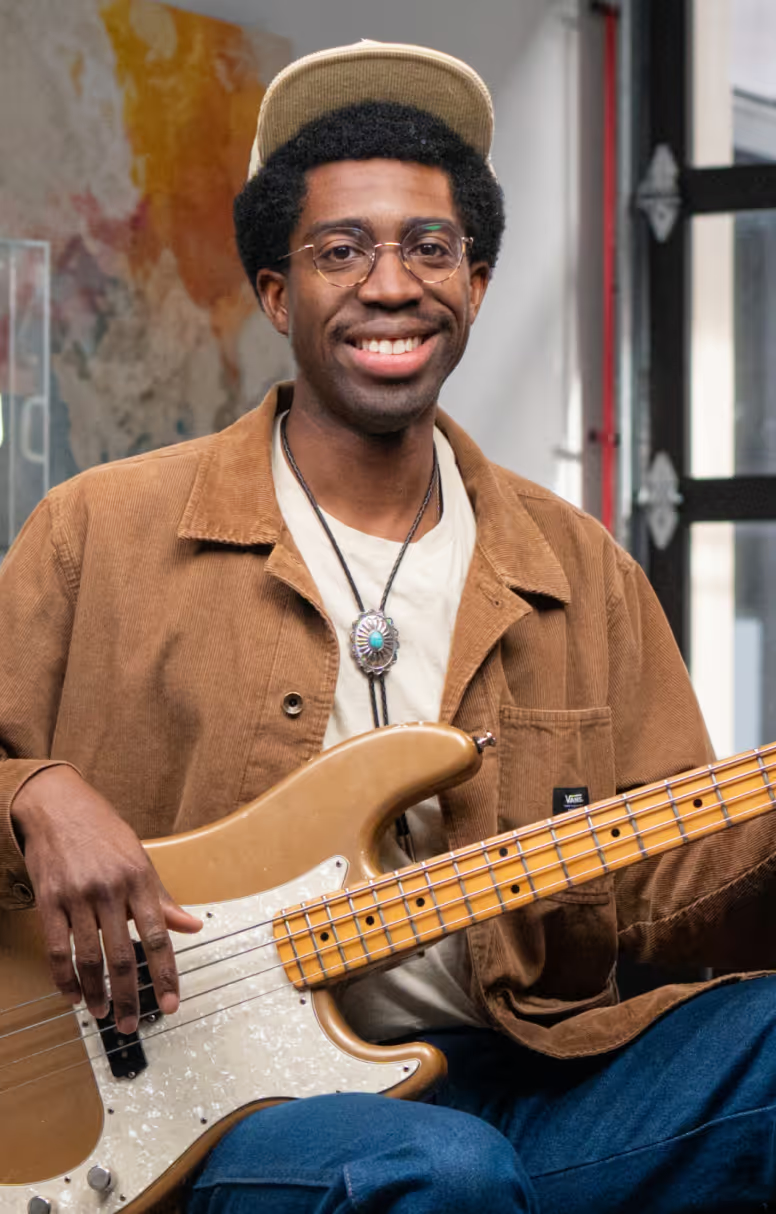
Embark on a journey to low-end mastery by learning fundamental skills from one of the hardest working bassists in the biz.
Explore LessonsLimitless learning.
All-inclusive access to every course.





FULL REFUND, NO QUESTIONS ASKED
Improve your playing or get your money back
We’re so confident that we can improve your playing that we’re underwriting your membership with a 60-day satisfaction guarantee.
Frequently asked questions

The most structured approach to learning music