Late Beginner Learning Pathway
Take the next step in your bass journey.


Beginner bassists
Comfortable with basic grooves and subdivisions? This is the next step after our Beginner Learning Pathway.
3 months
Corbin will guide you through 6 grades of step-by-step instruction with daily practice plans and assessments.
Confidence and creativity
By the end of this pathway, you'll be able to craft basslines on the fly and play with tight rhythm in any style.
Take the next step
Once you've mastered this class, keep progressing with more challenges and guided pathways.
What you'll learn
Leave the beginner level in the dust as you build confident command of your fretboard and lock in to new rhythms.
- Master essential grooves and tonal control
- Expand your vocabulary with versatile shapes
- Learn how to move like legendary bassists
- Unlock the power of slap bass


Curriculum
Stay focused with this step-by-step learning program designed by our expert team of music educators.
Grade 1. Back to Bassics
You’ve already built a strong bass foundation, so now it’s time to slow things down and zoom in on the most vital skills for progressing as a bassist. Something that separates beginners from pros is the ability to focus deeply on one concept, rather than move quickly from one skill to the next. This grade will help you become a more patient and intentional bass player.

Day 1. The most important rhythm
Bassists are a crucial link between the melody and the drums, so dialing in your rhythm is the smartest thing you can do to become a better player. Corbin will help you connect with the beat and create more momentum using the dotted quarter note.
Day 2. The tone zone
Just like bad rhythm would ruin a groove, so would bad bass tone. That’s why Corbin will show you what a good bass tone sounds like and how you can achieve different tones to serve different styles.
Day 3. Gettin’ ghostly
When you want to add rhythmic interest to your bassline without pitch, there’s no better technique than the ghost note. Learn how to mute your string just enough to add some thump to your lines.
Day 4. The anticipation is killing me!
As a member of the rhythm section, you should always know where you are in a measure. Corbin will help you do just that by teaching you how to count your rhythms. This will help as you add some momentum with rhythmic pushes.
Day 5. Pedal tones
A pedal tone is a technique to create tension and energy by holding one note while the chords around you keep changing. Corbin will show you how and when to play pedal tones to add a little intensity to a song or section.
Day 6. How to read a chord chart
Being able to read chord charts lets you track a song’s harmony without memorizing every detail. This is an essential skill if you’re interested in becoming a session bassist or learning a song quickly to play with a band. Corbin will show you how to read and follow chord charts.
Day 7. E-string workout
Improve your dexterity and stamina with a guided workout by your personal bass trainer, Corbin “gym bro” Jones. You’ll work on the rhythms you explored in Grade 1 while reviewing note names on the E string.
Performance pieces
Choose a song to learn that takes what you worked on in Grade 1 and puts it in a musical context. Here, you'll get to jam with a live-recorded band of pro-LA musicians as your backing track.
Personalized feedback
Submit a video of yourself playing a performance piece from this grade for custom video feedback on your playing from our team of pro bassists.
Final Quiz
Make sure you're ready to move on to Grade 2.
Grade 2. Shapes and Moves
You might think that mastering the fretboard requires years of memorizing each and every note of every key out there. Corbin’s here to demystify the process with some reusable shapes that can apply to any key. These shapes are called “moves” and they’ll make navigating the entire fretboard super easy.
Day 1. Getting comfortable with the box
The box is the most important shape you can learn on bass. We’ll revisit this essential shape to make sure you have it locked in and can play with ease. All the future moves we’ll look at will be based around this box shape.
Day 2. 5 to 6
The box is filled with small collections of notes (or “moves”) that you can copy and paste over every chord and progression. You’ll need just the root, 5th, and 6th for today’s move that connects two related box shapes and includes a silky-smooth slide.
Day 3. 2 to 3
The 2 to 3 move will give you some super cool major-sounding options. Learn how highlighting the 3rd makes your basslines sound more polished and impressive.
Day 4. R to 9
Corbin will show you how moving from the root to the 9th (or 2nd moved up an octave) adds a vibey quality to your lines. When used sparingly, this move will help you achieve a dreamy quality in your playing.
Day 5. Approaching the root
Playing the root on every 1 of the measure can quickly sound boring (and leave us as players bored). You’ll learn how to spice up the root by approaching it from below. This will let you emphasize where the downbeat is while building momentum leading into a section.
Day 6. The movable minor shape
Build out your box with the 2nd and minor 3rd to create a minor shape that you can move anywhere around the neck. This helpful shape gives you easy access to the most important notes for highlighting minor chords.
Day 7. Shapes and moves workout
Train those bass box biceps with another energetic workout from your low-end coach Corbin. Use this as a daily warmup to really lock in that box shape.
Performance pieces
Choose a song to learn that takes what you worked on in Grade 2 and puts it in a musical context. Here, you'll get to jam with a live-recorded band of pro-LA musicians as your backing track.
Personalized feedback
Submit a video of yourself playing a performance piece from this grade for custom video feedback on your playing from our team of pro bassists.
Final Quiz
Make sure you're ready to move on to Grade 3.
Grade 3. Styles and Grooves
Take all the basic skills and moves you worked on so far and apply them to some fun styles of music, including disco, reggae, and power rock. You’ll also learn perhaps the funkiest of all funk techniques out there: slap bass.
Day 1. Intro to slap
Slap is the easiest way to simulate the drummer’s kick and snare with your bass. Corbin will introduce you to this technique and give you some tips to slap and pop cleanly. You’ll set a strong foundation to continue working on slap throughout this pathway and beyond.
Day 2. Garage rock
Travel back to the ‘90s to explore the sacred drum and bass relationship inherent in garage rock. You’ll experiment with creating a brighter tone, and maybe even playing with a pick.
Day 3. Latin and reggaeton
Explore basslines in three different styles of Latin music, including Soca, Samba, and Cumbia. You’ll work on creating percussive basslines that differ from most Western styles of bass.
Day 4. Motown
Play some melodic, box-shaped basslines inspired by Motown legend James Jamerson. To emulate the classic Motown sound, you’ll learn how to create a round and punchy tone.
Day 5. Disco
Disco set the foundation for all 4-on-the-floor music we hear today, and the bass played a huge role in helping the people on the dancefloor shake their stuff. You’ll use a steady flow of octaves and chromatic approach notes to keep the song driving forward.
Day 6. Reggae
Reggae had a huge impact on music around the world: From gospel and R&B to Sting from The Police. Corbin will use this laid-back genre to help you practice arpeggios and the 1-drop, where you drop the 1 of the measure and emphasize the 2 and 4.
Day 7. Power rock
In power rock, the bass takes on a more important role to allow the guitarist room to solo. You’ll learn how to interact with other musicians in the band other than just the drummer while holding down the harmony. You might even get a spotlight thrown on you at some point today, so be ready.
Performance pieces
Choose a song to learn that takes what you worked on in Grade 3 and puts it in a musical context. Here, you'll get to jam with a live-recorded band of pro-LA musicians as your backing track.
Personalized feedback
Submit a video of yourself playing a performance piece from this grade for custom video feedback on your playing from our team of pro bassists.
Final Quiz
Make sure you're ready to move on to Grade 4.
Grades 4-6
Explore the style of iconic bassists, expand your fretboard knowledge, and dive into advanced expressive techniques.
Grade 4. Study the Greats
As a student of the bass, one of the best ways to improve your playing is to study the players who influenced the history of the instrument, and that’s just what we’ll do in this grade. With Corbin as your guide, you’ll explore the funk-pop style of Flea and the funkadelic playing of Bootsy Collins, among many other iconic bassists.
Day 1. John Paul Jones
Tap into the raw melodic power of Led Zeppelin’s John Paul Jones and combine rock with soul-inspired groove. This lesson will help you dial in a cutting bass tone that really stands out.
Day 2. Louis Johnson
Exploring Louis Johnson’s slap-heavy sound shows us how the bass can support the band rhythmically while still adding some flair and fun. This lesson will help you transition between fingerstyle and slap.
Day 3. Flea
Flea was one of the first bassists to combine punk, slap, and funk. You’ll learn his chaotic and treble-heavy slap technique to go toe-to-toe with any guitarist for the starring role in the band.
Day 4. Carol Kaye
Carol Kaye was a member of the famous group of session players known as the Wrecking Crew, and she remains one of the most recorded bass players ever. Like Carol Kaye, you’ll use a pick to create a sharp attack. You’ll also learn about her “Tic Tac bass” style, which doubled an upright bass for a fuller sound.
Day 5. Bootsy Collins
Bootsy Collins is the sun that all other funk bassists revolve around. Corbin will show you how to emulate Bootsy Collins’ unique styles by gettin’ weird and always landing on the 1.
Day 6. James Jamerson
James Jamerson is one of the most important figures in the electric bass and the Motown sound. Corbin will show you how to channel Jamerson’s iconic style to approach triadic chord tones and chromaticism.
Day 7. Honorable modern mentions
There are so many great bassists out there now. We just want to highlight a few for you to learn from. Corbin will show you how to be minimalist but expressive like Vulpeck’s Joe Dart, and then he’ll show you how less can be more with the melodic basslines of Khruangbin’s Laura Lee. Last but definitely not least is Thundercat’s wild technique and harmony rooted in the groove.
Performance pieces
Choose a song to learn that takes what you worked on in Grade 4 and puts it in a musical context. Here, you'll get to jam with a live-recorded band of pro-LA musicians as your backing track.
Personalized feedback
Submit a video of yourself playing a performance piece from this grade for custom video feedback on your playing from our team of pro bassists.
Final Quiz
Make sure you're ready to move on to Grade 5.
Grade 5. Expanding Your Fretboard
You might think that learning scales is boring. That’s true only if you study scales in a boring way. Corbin’s got the solution with interesting musical examples that will show you how and when to use each scale. No mundane and rhythmless scale runs allowed in this grade.
Day 1. Major review
You’re already familiar with the major scale, but Corbin is going to show you how to make the major scale useful in a real-world musical context. You’ll learn the number system, which assigns a number from 1 to 7 to each note. This system is how professional musicians and producers communicate with each other to make sure that everyone is on the same page (or note).
Day 2. Major pentatonic
Remove the 4 and 7 from the major scale and we have the major pentatonic. Pentatonics are so useful because they include only the notes that sound great over diatonic chords (AKA chords in the same key). Corbin will show you the best way to finger this scale to create your basslines on the fly.
Day 3. Natural minor
Time to meet the major scale’s melancholic twin: the natural minor scale. Tons of amazing songs are written in minor keys. This scale will open the door to learning these and creating your own pensive basslines.
Day 4. Minor pentatonic/blues scale
Just as we did with the major pentatonic, let’s distill the minor scale into just the most important notes. We’ll remove the 2 and b6 to get the minor pentatonic scale. Add the b5 and we have the blues scale. These two scales are among the most used scales in all of modern Western music.
Day 5. Major and minor triads
We covered major triads in the Beginner Learning Pathway, but these are some of the most important shapes for bassists, so it’s worth the time to review them and learn their minor versions. Learn how these triadic shapes are perfect for supporting the harmony without overcomplicating things.
Day 6. To 3rd or not to 3rd
Now that you have a stronger grasp on triads, it’s vital to understand how to use them responsibly. This means learning when and when not to include the 3rd. Corbin will guide you through the situations in which you might want to sit back and support with root-5th or stand out by including that 3rd.
Day 7. Triad tree workout
To cap off Grade 5, drill your triad shapes until you’ve got them locked in.
Performance pieces
Choose a song to learn that takes what you worked on in Grade 5 and puts it in a musical context. Here, you'll get to jam with a live-recorded band of pro-LA musicians as your backing track.
Personalized feedback
Submit a video of yourself playing a performance piece from this grade for custom video feedback on your playing from our team of pro bassists.
Final Quiz
Make sure you're ready to move on to Grade 6.
Grade 6. Bass Techniques
Now that you’ve conquered the fretboard, it’s time for you to start carving out your own sound as a true bass boss. This final grade is all about the subtle techniques that separate beginners from pros, getting you ready to jam with the best of ‘em.
Day 1. Slap and pop
You got a taste of slap. It’s time to really get serious about our slap technique. Corbin will break this technique down and give you the essential tips to master this funky skill. You’ll be able to integrate it into your own playing right away.
Day 2. 4 on the fretboard
Bassists are known for shredding, but that doesn’t mean we can’t rip a solo from time to time. You’ll learn how to play higher up on the fretboard using one finger per fret. Getting your middle and ring fingers involved opens the door to faster, more intricate lines.
Day 3. Pull-offs
You already know hammer-ons, so now it’s time to learn about their counterpart: pull-offs. By flicking your fretting-hand finger off the string, you can make it ring as if you plucked it. Combining hammer-ons and pull-offs unlocks effortless legato playing.
Day 4. The rake
As you progress into the intermediate stage of your bass journey, you’ll encounter faster lines that require more efficiency to play cleanly. This is where the economic motion known as the rake comes in. Using just one finger, you’ll learn how to efficiently move down the strings faster.
Day 5. Playing off the kick drum
We’ve talked about the sacred relationship between the drums and bass. Now, we’ll complicate things by exploring three ways to play both on and off the drums and give the track more rhythmic interest.
Day 6. Low-end harmony
Taste the forbidden fruit of bass chords. Corbin will give you three tasty chord voicings that you can use to enhance the harmony and even add color. You’ll learn about the power chord, 10ths, and the tension-filled tritone.
Day 7. 1234 4321 workout
For your final workout of the pathway, you’ll boost your finger strength and dexterity with the spider exercise.
Performance pieces
Choose a song to learn that takes what you worked on in Grade 6 and puts it in a musical context. Here, you'll get to jam with a live-recorded band of pro-LA musicians as your backing track.
Personalized feedback
Submit a video of yourself playing a performance piece from this grade for custom video feedback on your playing from our team of pro bassists.
Final Quiz
Make sure you're ready to move on to new challenges.

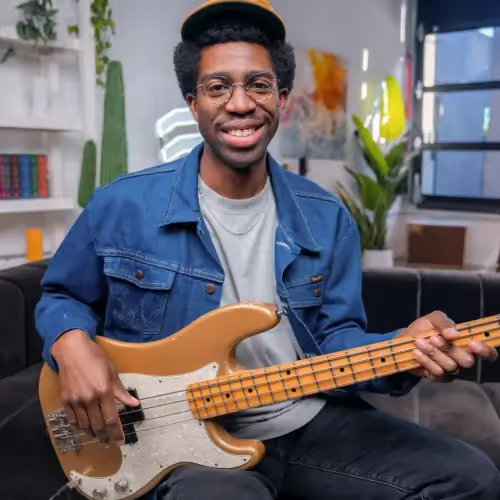
Your Instructor
Embark on a journey to low-end mastery by learning fundamental skills from one of the hardest working bassists in the biz.
Explore LessonsLimitless learning.
All-inclusive access to every course.





FULL REFUND, NO QUESTIONS ASKED
Improve your playing or get your money back
We’re so confident that we can improve your playing that we’re underwriting your membership with a 60-day satisfaction guarantee.
Frequently asked questions

The most structured approach to learning music