Beginner bassists
This class is designed for beginner and late beginner players. You'll start with funk fundamentals and work up to more advanced techniques.
3 months
Nick will guide you through 6 grades of step-by-step instruction with daily practice plans and assessments.
Play in the pocket
This class will help you build groove-driven basslines using essential funk techniques from classic and modern styles.
Take the next step
Once you've mastered funk bass, keep progressing with advanced challenges and guided pathways.
What you'll learn
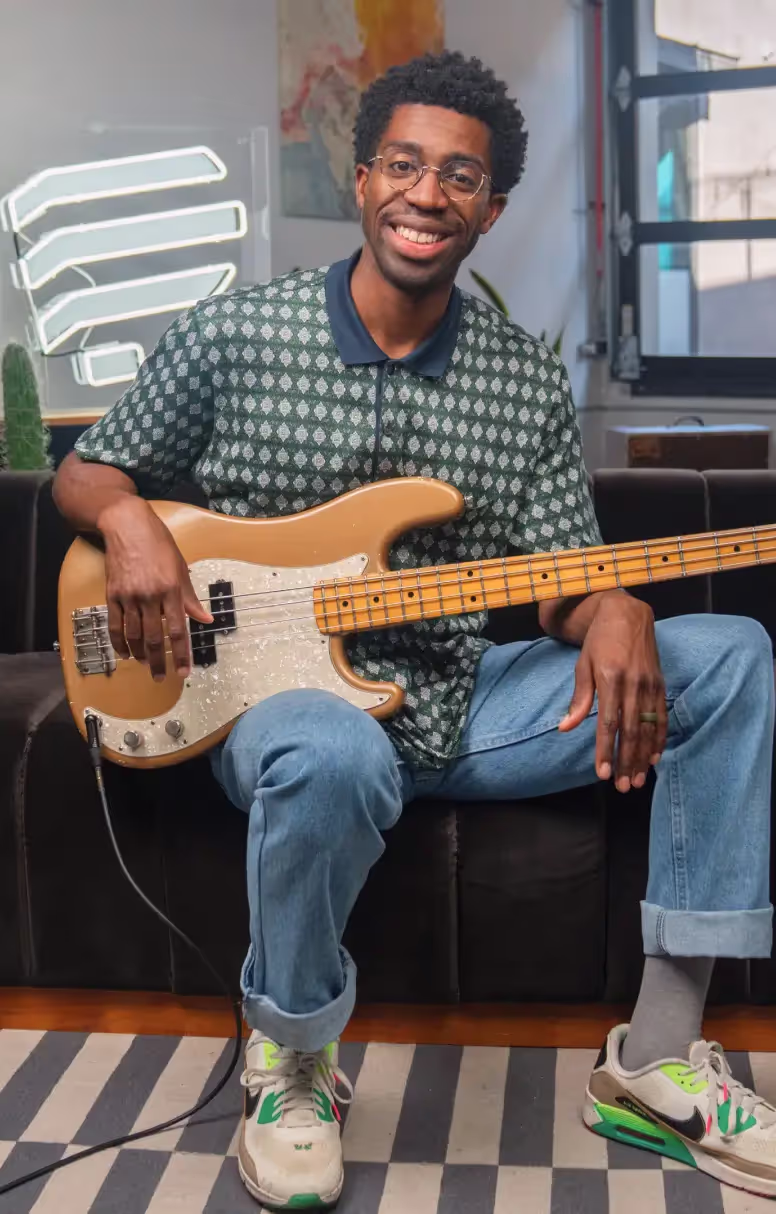
In this class, Nick Cisneros breaks down the core techniques behind unshakable funk basslines. Each day, you’ll dig into guided exercises and jams that sharpen your rhythm and help you sit deep in the pocket of a groove.
- Improve your pocket and time feel
- Learn how to play slap bass
- Compose your own funky basslines
- Lock in with the drums

Curriculum
Stay focused with this step-by-step learning program designed by our expert team of music educators.
Grade 1. The DNA of Funk
Build the fundamentals that every great funk bassist has used to bring the groove. In this opening grade, you’ll focus on the one and work on subdividing the beat to complement the drummer. You’ll also build more groove control with techniques like ghost notes, legato, and pentatonics.

Day 1. Funk starts on the one
You'll learn how you can get as wild as you want with your other notes as long as you always return to the most important beat of all: the one.
Day 2. The space between the beats
Learn to recognize and count 8th and 16th-note subdivisions so you can lock into funk rhythms between the beats.
Day 3. Less motion, more groove
Learn how to conserve energy while making your basslines smoother using hammer-ons and pull-offs.
Day 4. The notes we don’t play
Strengthen your muting and ghost-note control to emphasize the punchiness of your basslines.
Day 5. The power of three
Learn how to outline the harmony with major and minor triads while staying locked into the groove.
Day 6. That funky scale
Start building basslines and improvising with the minor pentatonic scale. By the end of today, you’ll understand why this scale shows up everywhere.
Day 7. Subdivision workout
Strap on your headband and strengthen your internal time with a counting-heavy workout that brings all the essential rhythmic concepts together.
Performance pieces
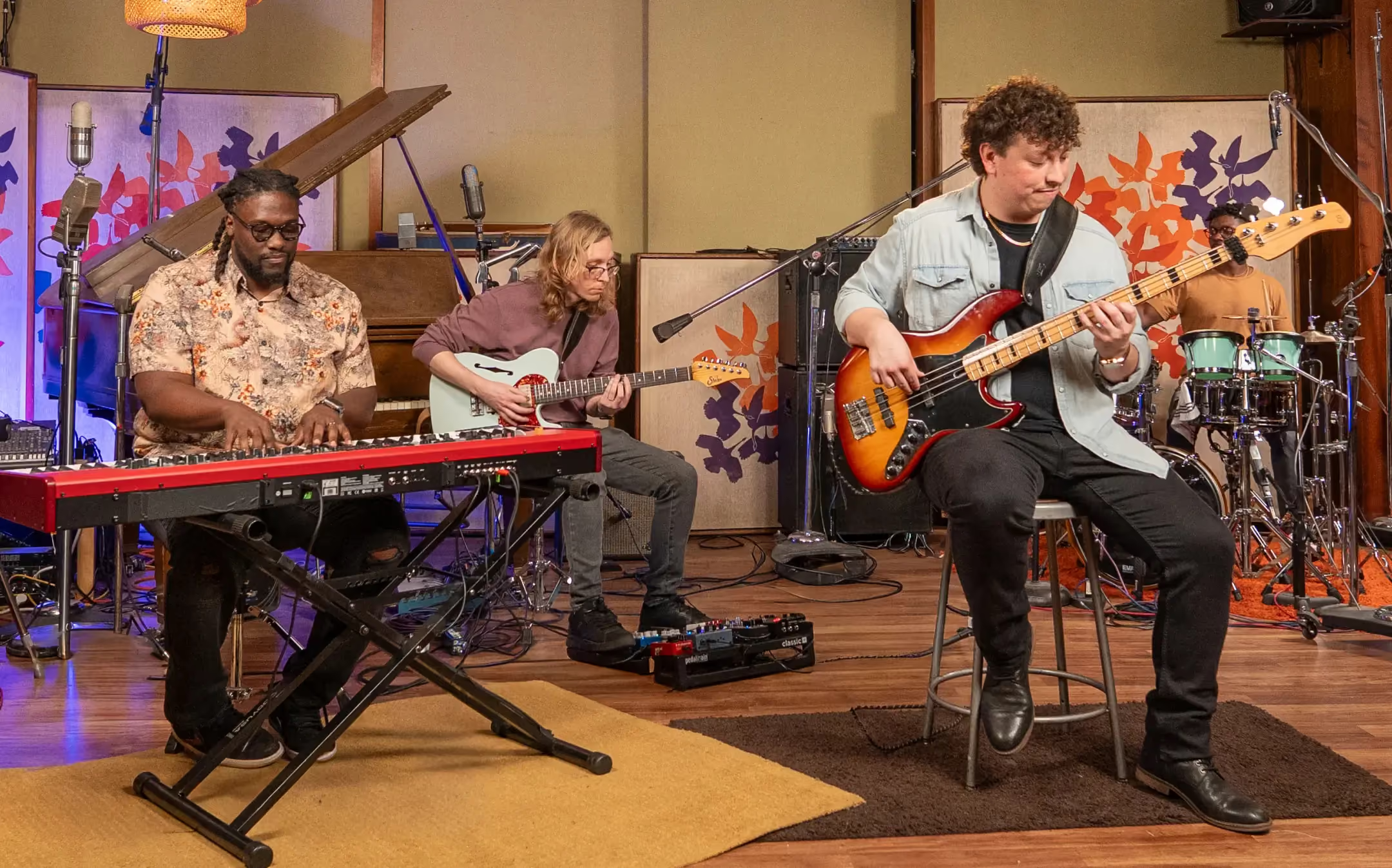
Choose a song to learn that takes what you worked on in Grade 1 and puts it in a musical context. Here, you'll get to jam with a live-recorded band of professional L.A. musicians as your backing track.
Personalized feedback
Submit a video of yourself playing a performance piece from this grade for custom video feedback on your playing from our team of pro bassists.
Final quiz
Make sure you're ready to move on to Grade 2.
Grade 2. Learn Your Funk-isms
With your fundamentals in the bag, it’s time to start adding more flavor to your basslines with the essential funk techniques every bassist should know. From constant 16th notes and the blue note to octaves and double stops, these techniques will add some serious flair to your lines.
Day 1. Anticipation
Add funky syncopation by anticipating the one and learning how funk lives in the offbeats.
Day 2. Rocco 16ths
Drive the beat with constant 16th notes inspired by Tower of Power’s Rocco Prestia. You’ll also hone your alternate-plucking skills today.
Day 3. The blue note effect
Create tension and release by using the flat 5 as a passing tone.
Day 4. Down the funk slide
Add funky excitement to your basslines with ascending, descending, and multi-string bass slides.
Day 5. Chromatic walkups
Use non-diatonic notes to build momentum and smoothly connect your target notes.
Day 6. Octaves
Unlock one of the funkiest techniques in bass by learning how to groove with octaves.
Day 7. Double stops
Add harmonic crunch to your basslines with dominant-7th double stops. You’ll make this technique even funkier with slides and a trill.
Performance pieces
Choose a song to learn that takes what you worked on in Grade 2 and puts it in a musical context. Here, you'll get to jam with a live-recorded band of pro L.A. musicians as your backing track.
Personalized feedback
Submit a video of yourself playing a performance piece from this grade for custom video feedback on your playing from our team of pro bassists.
Final quiz
Make sure you're ready to move on to Grade 3.
Grade 3. The Roots of Funk
Step into the Magic Funk Bus to go back in time and study from the greats. Learn the techniques behind funk icons like James Brown, Sly and the Family Stone, and Prince and expand your funk toolkit.
Day 1. James Brown
Return your focus to the one and learn how the bass worked with the drums to drive James Brown’s grooves.
Day 2. The Meters
Use simple pentatonic lines and rhythmic variation to capture the New Orleans funk of The Meters.
Day 3. The Time
Study The Time to learn how you can establish the groove and carry an entire song with just short, repetitive basslines.
Day 4. Rick James
Join the entire band to play unison lines and octaves. Let Rick James show you how to make your bass sound bigger and more melodic.
Day 5. Sly and the Family Stone
Channel Larry Graham with an 8th-note bounce that becomes the heartbeat of the band.
Day 6. Tower of Power
Build on Rocco-style 16ths with ghost notes, muting, and octaves.
Day 7. Prince
Study how Prince combined simple yet precise basslines with careful feel and intention to create some of the most beloved funk songs of all time.
Performance pieces
Choose a song to learn that takes what you worked on in Grade 3 and puts it in a musical context. Here, you'll get to jam with a live-recorded band of pro L.A. musicians as your backing track.
Personalized feedback
Submit a video of yourself playing a performance piece from this grade for custom video feedback on your playing from our team of pro bassists.
Final quiz
Make sure you're ready to move on to Grade 4.
Grades 4-6
These final grades are where your funk playing really opens up. You’ll dive into slap bass and explore the modern techniques behind today’s funk icons. You close out the class by combining your funk-isms into more advanced musical ideas that prepare you for the stage and studio.
Grade 4. Getting Slap Happy
Let’s be real: This is probably why you’re taking this class. It’s probably why you started learning bass in the first place. In this grade, you’ll start thinking more like a drummer as you hone your slapping and popping skills. You’ll build solid slap fundamentals and combine them with articulation techniques to increase the funk factor.
Day 1. Thump funk
Learn how to mimic a kick drum with your thumb. Nick will break down how to build a clean thump technique step by step.
Day 2. Single pops
Complement the thumb with bright, snare-like pops on the higher strings. Work on your hand positioning using just the right amount of pop to make those strings nice and snappy.
Day 3. Applying ghost notes
Now that you have your slap mechanics dialed in, you’ll add subtle percussion to your slap technique with ghosted thumps and pops.
Day 4. Slapping the pentatonic
Become an unstoppable funk force by combining one of the funkiest of all techniques with one of the most important scales.
Day 5. Slap bass hammer-ons
Add speed and personality to your slap lines with hammer-ons. Nick will guide you through using hammer-ons with both thumps and pops.
Day 6. Slap groupings
Tackle your first slap lick with double thumps, octaves, and grouped rhythms. After today, you’ll have a practical lick you can use throughout your bass career.
Day 7. Hand combination
Use both hands together to create a movable slap lick with open strings, hammer-ons, and pops.
Performance pieces
Choose a song to learn that takes what you worked on in Grade 4 and puts it in a musical context. Here, you'll get to jam with a live-recorded band of pro L.A. musicians as your backing track.
Personalized feedback
Submit a video of yourself playing a performance piece from this grade for custom video feedback on your playing from our team of pro bassists.
Final quiz
Make sure you're ready to move on to Grade 5.
Grade 5. Modern Funk
In this grade, you’ll study the modern bassists who are redefining funk. From Flea and Joe Dart to Anderson .Paak and Thundercat, you’ll learn how today’s players adapt classic funk concepts to modern grooves and styles.
Day 1. Red Hot Chili Peppers
Add some punk to your funk with Flea’s patented heavy attack style. You’ll combine this with funk-isms like chromaticism and funk slides to create some funk-rock lines.
Day 2. Jamiroquai
Bring disco into the modern era with 16th-note plucking and disco-octave grooves inspired by Jamiroquai.
Day 3. Bruno Mars
Deck yourself out in 24K gold with Bruno Mars. Learn how simple yet tight basslines can support pop-funk grooves with feel and consistency.
Day 4. Lettuce
Dive deeper into the relationship between drums and bass using precise placement, short lines, and deep pocket.
Day 5. Vulfpeck
Does it get any cooler than Joe Dart? You’ll focus on simplicity and precision while building a bassline that includes quarter, 8th, and 16th notes.
Day 6. Anderson .Paak
Ok, it gets cooler. Sit deeper in the pocket with Anderson .Paak-inspired basslines that lock into the rhythm section.
Day 7. Thundercat
Expand the role of the bass with funk’s most innovative bassist. Learn how funk can move beyond single-note lines as long as the groove remains strong.
Performance pieces
Choose a song to learn that takes what you worked on in Grade 5 and puts it in a musical context. Here, you'll get to jam with a live-recorded band of pro L.A. musicians as your backing track.
Personalized feedback
Submit a video of yourself playing a performance piece from this grade for custom video feedback on your playing from our team of pro bassists.
Final quiz
Make sure you're ready to move on to Grade 6.
Grade 6. Where the Funk Comes Together
In this final grade, you’ll bring everything you’ve worked on together into a more advanced approach to funk bass. You’ll focus on playing with greater intention and personality. This is where your basslines begin to sound more natural and uniquely your own.
Day 1. Combining fingerstyle and slap
Develop the ability to move more freely between plucking and slapping so you can better adapt to each musical situation.
Day 2. The funk chord
Build a stronger sense of harmony without losing your groove using major-10th double stops.
Day 3. Advanced ghosting
Use layers of ghost notes and articulations to make simple basslines even funkier. You’ll combine ghost notes with other funk-isms like hammer-ons and chromaticism.
Day 4. Dynamics in funk
Learn to control your intensity so your playing has more contrast and emotional impact. This is where your touch starts to define your sound.
Day 5. Disco doubles
Bring back octaves, but go full disco mode by doubling the top octave. This is an essential skill for playing disco.
Day 6. Pentatonic groupings
Rethink pentatonics with an often-overlooked technique. Grouping pentatonic notes is a fantastic way to add movement to your lines while using only a handful of notes.
Day 7. The Brazilian funk connection
Expand your rhythmic awareness by experiencing groove from a different perspective. Study how Brazilians incorporated funk into their music.
Performance pieces
Choose a song to learn that takes what you worked on in Grade 6 and puts it in a musical context. Here, you'll get to jam with a live-recorded band of pro L.A. musicians as your backing track.
Personalized feedback
Submit a video of yourself playing a performance piece from this grade for custom video feedback on your playing from our team of pro bassists.
Final quiz
Make sure you're ready to move on to new challenges.


Limitless learning.
All-inclusive access to every course.



FULL REFUND, NO QUESTIONS ASKED
Improve your playing or get your money back
We’re so confident that we can improve your playing that we’re underwriting your membership with a 60-day satisfaction guarantee.
Frequently asked questions

The most structured approach to learning music