Soloing Learning Pathway
Learn to play guitar solos that sing.


Qualified intermediate
Feeling bored with your soloing? We'll teach you how to solo effortlessly and navigate modes with ease.
3 months
Sam and Karl will guide you through six grades of instruction with daily practice plans and assessments.
Play spellbinding solos
By the end of this pathway, you'll be able to fluidly improvise and tell captivating stories with your guitar.
Take the next step
Once you've built your soloing foundation, take your skills to the next level with genre-specific pathways.
What you'll learn
In this pathway, you'll master the art of the guitar solo – from simple pentatonic licks to advanced modal sounds.
- Make your solos sing with expressive techniques.
- Address chord changes with ease.
- Learn how to tell a story with phrasing & dynamics.
- Decode major scale modes across your fretboard.

%20(1).avif)
Curriculum
Stay focused with this step-by-step learning program designed by our expert team of music educators.
Grade 1. Start Soloing Now
To kick off your lead guitar journey, you'll jump headfirst into soloing by running through a series of core soloing concepts that'll get you playing right away.
This includes quick ways to "play the changes," play in the pocket, and make your solos more melodic.

We're with you every step of the way in this Learning Pathway. In every lesson, Sam will break down a new concept and run through mini drills with you so you can lock it into your muscle memory. To cap off each day's work, you'll put what you learned in a musical context with a guided jam session.
Day 1. How to solo in four steps
Today is not the day to overthink things! Sam will guide you through four shortcuts to lead guitar playing so you can start soloing right away. You'll learn how to use triads, the pentatonic scale, the major scale, and maj7 arpeggios as core soloing tools.
Day 2. Take it to the IV
Today, you’ll learn how to solo over a progression with two chords using ever-popular I–IV combo as an example.
Day 3. How to solo on a I7 vamp
Today’s lesson will prepare you for a typical jam situation: When your keyboard and bass player groove out on one single chord, and it’s your time to shine. Sam will show you how to avoid running out of fresh ideas after four bars.
Day 4. How to play what you hear
When we guitarists start our soloing journey, we often rely on scale shapes and choose notes based on box-shaped maps across the fretboard. However, the best soloists craft a solo using their ear. Today, Sam will show you how you can start developing a stronger connection between your ear and your instrument.
Day 5. Playing in the pocket
Today’s lesson is all about time feel. As the term suggests, timing in music has a lot to do with how music feels and less with which notes you play. Sam will guide you through this key concept with a series of drills.
Day 6. Intro to melodic soloing
Today, we’ll explore the art of sweet-sounding melodic soloing. You'll explore arpeggios, pentatonic string skipping, and one-string scales to ramp up the melodic aspects of your playing.
Performance pieces
Perform songs that incorporate the concepts you just learned in a purely musical context. Here, you'll have the opportunity to jam with a live-recorded band of pro musicians. You can submit your performance to the Pickup Music team for personalized video feedback – who said online learning wasn't interactive?!
Final quiz
Cap off the grade with a quiz to make sure you've adequately absorbed the core concepts involved.
Grade 2. Bread and Butter Soloing
Now, you’ll build a foundational lead guitar vocabulary and learn to solo in a wide variety of genres and styles. From funk and hard rock to soul and R&B, you'll be ready for nearly any musical situation by the end of this grade.
Day 1. Funkin’ it up: I7 to IV7
This lesson will challenge you to step outside of your comfort zone by running you through the full Mixolydian scale, the jazz-tastic magic of chromatic notes, and 6th intervals for traveling across the fretboard.
Day 2. Those Mayer vibes
Ever wonder how the pros manage to hit the sweet spot so often with their solos? Let’s take a look at Mr. John Mayer’s handiwork. Today, you’ll discover how to augment the silky sounds of the minor pentatonic scale by outlining chord changes.
Day 3. 70s funk ‘n’ soul – IIm7 V7
70’s funk has some of the most common, must-know grooves for guitarists. In today’s lesson, you'll learn how to blend E minor pentatonic and A Mixolydian sounds to funk it up and make it soulful.
Day 4. Hard rock won’t stop
Rock heavyweights like AC/DC, Led Zeppelin, and Black Sabbath packed their songs full of spine-tingling licks and riffs that drew on the blues and minor pentatonic scales. These rock licks in this lesson are a must-know for all guitar players.
Day 5. Intro to secondary dominant soloing
Today’s lesson is designed to help you master how to play over secondary dominant chords inspired by George Harrison’s Something. Karl will walk you through three techniques to use when soloing over secondary dominant chords to keep them sounding fresh and musical.
Day 6. Khruangbin Vibes (harmonic minor)
Sometimes the minor pentatonic or natural minor scales aren’t enough when crafting a solo in a minor key. Learning the harmonic minor scale can be the antidote you didn’t know you needed!
Day 7. R&B chord soloing
What's bread without a little butter? Today, you’ll step into the velvety world of R&B to learn how to build a chord solo. In this lesson, Karl will use the certified R&B banger Best Part by Daniel Caesar ft. H.E.R to walk you through three key concepts for learning how to chord solo.
Performances
Put your skills to the test with three tasteful solos. As always, you'll have the live-recorded Pickup Music band backing you up while you solo.
Get feedback
Get personalized video feedback on your playing from the Pickup team.
Final quiz
Make sure you're ready for Grade 3.
Grade 3. 7 Modes in 7 Days.
After that, you'll demystify modes to outline chords with sophisticated solos. Sam has a special knack for making modes stupid simple – he'll show you exactly how, when, and (most importantly) when not to use modes.
Day 1. What are modes?
More importantly... What aren't modes? Simply put, knowing how to navigate modes separates advanced musicians from beginning guitarists. Over the course of this grade, we’ll show you when and how to play them.
Day 2. C Lydian
Today, we’ll get familiar with the 4th mode of the major scale. Lydian provides an uplifting, whimsical, and all together ethereal sound. It’s constructed a lot like Ionian, but instead of a natural 4th, it contains an #4th scale degree that defines the sound.
Day 3. C Mixolydian
Today we’ll get acquainted with the 5th mode of the major scale. Mixolydian is favored by jam bands, blues veterans, psych-rockers, jazz players – you know, all the fun music to solo over! Once again, the construction is similar to Ionian. Only difference is that Mixolydian has b7. If the modes were ninja turtles, Mixolydian would definitely be Michaelangelo. Party on. 🍕
Day 4. C Dorian
Here, you'll get acquainted with the second mode of the major scale. Dorian is a fun and jazzy minor-sounding mode. It’s one of the more popular minor modes due to its near-dominant sound, penchant for twanging tonalities, and cool jazz sensibilities. Its construction is similar to Mixolydian, but with a b3 creating its minor flavoring.
Day 5. C Aeolian
Aeolian is the most common of the minor-sounding modes. It’s the other side of the relative major-minor relationship – the yang to Ionian’s yin. If a song is in a minor key, Aeolian is the go-to scale. It’s far more common than Dorian, and its b6 gives it a touch of sadness as well as an almost-classical sound.
Day 6. C Phrygian
Two more minor modes to go! Day 6 has us exploring the third mode of the major scale – Phrygian. This dark and mysterious-sounding minor mode is a delight to solo over. Phrygian is less commonly found in Western pop music. Its exotic flamenco-inspired tonality will make it stand out from everything you'll have done so far in Grade 3.
Day 7. C Locrian
One more mode to go, the seventh mode of the major scale – Locrian. More exotic and even more adventurous than Phrygian, Locrian is the least-commonly used of the four minor modes. Thrash metal enthusiasts will be familiar with its harmonic brutality, as well as jazz players seeking to outline every nook and cranny of a standard.
Performances
Demonstrate what you've learned in a musical context by learning original solos.
Get feedback
Get personalized video feedback on your playing from the Pickup team.
Final quiz
Make sure you're ready for Grade 4.
Grade 4-6.
Finally, you'll deepen your understanding of major scale modes and learn how to add your own voice to solos with phrasing and dynamics. You'll also study how different instructors approach the same track to develop a more personal soloing style.
Grade 4. Master the Modes of G Major
In this grade, you'll link up with Pickup's Head of Education, Karl Kerfoot, to continue exploring major-scale modes. These lessons will challenge you to map out your fretboard while deepening your understanding of modes as they relate to different moods and sounds.
Day 1. G Ionian (pop)
Revisit the major scale in G and apply it to pop sounds.
Day 2. A Dorian (funk)
Get your minor ii chord ready, it’s time to funk it up with A Dorian. You might recognize today's funk jam, which is inspired by Vulfpeck’s Beastly.
Day 3. B Phrygian (psych rock)
Tame Impala called, he wants his scale back. This mysterious and dark-sounding mode is used in Flamenco and Spanish music. It’s one of the more “unstable” modes, which makes it great for psychedelic sounds.
Day 4. C Lydian (ethereal pop)
Time to talk about Lydian – it isn’t that different from the major scale in its construction, but the two modes have strikingly different sounds. This mode is easily accessible in that you don’t have to do a ton of shifting to access the sound.
Day 5. D Mixolydian
Run it up to the 10th fret – it’s time to dive back into the versatile (and often funky) sounds of Mixolydian.
Day 6. E Aeolian
Today, we’re digging into a minor-sounding mode to access the buttery-smooth sounds of neo-soul guitar. 🧈🎸You’re likely already comfortable with most of the E Aeolian sound by way of the pentatonic scale.
Day 7. F# Locrian (metal)
For your last lesson of Grade 4, we’re turning things up to 11 and diving back into the gritty sounds of F# Locrian.
As you might remember, Locrian is the least-commonly used of the four minor modes. Today, you'll harness Locrian via a metal song inspired by the original Doom video game soundtrack.
Performances
Demonstrate what you've learned in a musical context with more solos that synthesize what you've been working on.
Get feedback
Get personalized video feedback on your playing from the Pickup team.
Final quiz
Make sure you're ready for Grade 5.
Grade 5. How to Craft a Solo
In this grade, we'll set aside modes and other vocabulary to focus on a conceptual approach to soloing that'll turn you into a compelling musical storyteller.
Day 1. Phocus on phrasing
The most memorable solos are created using clear and purposeful phrasing, and that’s exactly what we’ll focus on today. No more scales, licks, or theory – your solos are about to get 10 times more exciting in this grade.
Day 2. Dynamic phrasing
Volume control is a hallmark of any master soloist. Today’s exercises will help you switch up your dynamic approach and keep your ideas fresh.
Day 3. Switching pickups
Electric guitarists have a wide and wonderful world of tones under their fingers. Even before introducing pedals, the pickup switch can offer a vast collection of guitar sounds that might previously have been overlooked. Learning how and when to switch your pickups mid solo is not only a vibe changer, it’s a game changer.
Day 4. Harmonic density
Harmonic density – sounds confusing, but it's a simple concept you can use to create a sense of depth and emotional resonance in your music.
Day 5. Rhythmic Density
Rhythmic density is the spice that brings a musical dish to life, infusing it with flavor and excitement. To start your exploration into rhythmic density, Karl has prepared 4 exercises that look at different ways to fill space using triplets, 16ths, quintuplets, and sextuplets.
Day 6. Register this!
Exploring the full range of a guitar's register is like unlocking a musical universe, where dynamics soar to new heights and creativity knows no bounds. Today you'll work on mastering your guitar’s full register by developing the ability to fluidly play a lick or phrase in three different pitches across the guitar neck.
Day 7. Sing it, learn it
This final lesson will take aim at your ability to sing and internalize your musical ideas. As the old saying goes, “If you can sing it, you can play it.”
Performances
Tackle new tunes to apply what you've learned in a musical context.
Get feedback
Get personalized advice on your playing from the Pickup team.
Final quiz
Make sure you're ready for Grade 6.
Grade 6. One Track, Three Solos
To cap off your hard work, you'll learn three solos penned by Karl Kerfoot, Arianna Powell, and Rafa Rodriguez. These are designed to give you insight into how different pro players craft a solo.
Day 1. Golden Mean
What can geometry do for you? Today, you’ll tackle two things: (1) A basic template for creating a guitar solo.
(2) The fundamentals of the track we’ll use for all three solos in this grade. You'll also learn how the Golden Mean concept can inform the dynamic progression of your solo.
Days 2 & 3. Karl's solo
First, Karl Kerfoot kicks things off with his solo. For each artist, you’ll be able to watch them performing their solo, talk about their process, and finally there’ll be a lesson that walks through the solo note by note.
Days 4 & 5. Arianna's solo
Days 4 and 5 are dedicated to the second of our three solos. You'll explore a whole new set of ideas over the same tune as Arianna Powell (Olivia Rodrigo, Halsey) guides you through her composition.
Days 6 & 7. Rafa's solo
A new player has entered the room. Today, you’ll embark on a new solo adventure with your guide: virtuosic guitarist Rafa Rodriguez.
Performances
Finish out the Learning Pathway with one final challenge.
Get feedback
Get personalized advice on your playing from the Pickup team.
Final quiz
Cap off your hard work and make sure you're ready to move on.

REAL students
Don’t take our word for it, take theirs
What guitarists love about this course

Your Instructor
Sam Blakelock
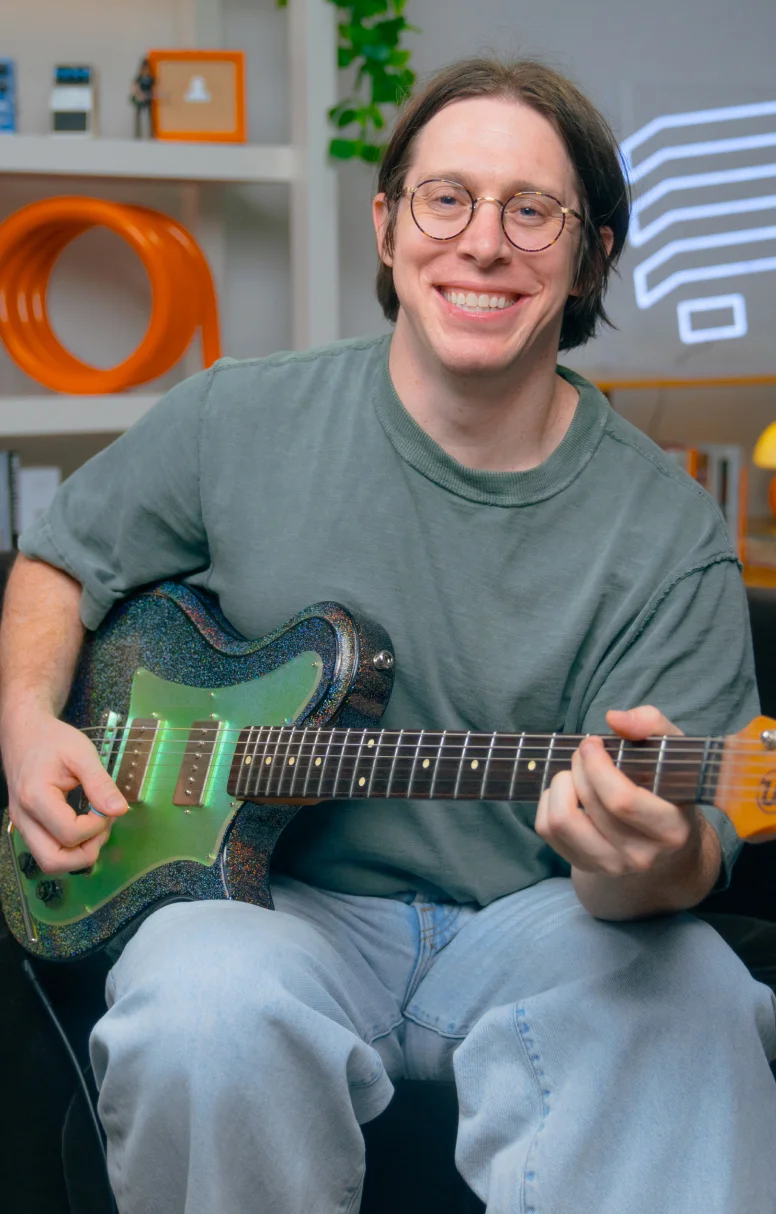
Sam Blakelock is a guitarist, educator, and the founder of Pickup Music. He's an expert at helping guitarists of all levels tackle fundamental techniques and complex topics in a straightforward & practical way.
Explore LessonsLimitless learning.
All-inclusive access to every instrument and course.





FULL REFUND, NO QUESTIONS ASKED
Improve your playing or get your money back
We’re so confident that we can improve your playing that we’re underwriting your membership with a 60-day satisfaction guarantee.
Frequently asked questions

The most structured approach to learning music